Almost exactly a year ago, I posted a piece about the (to me still unfamiliar but) utterly exhilarating experience I’d just had in singing the last movement of Beethoven’s Ninth with a local choir, the Queen’s Park Singers – an ode to joy indeed, given that I’d only joined them a few months before, with no history of singing in public and being at that time barely able to read music. I reassured readers, in that piece, that I had no intention of writing about each and every concert I sang in, and that undoubtedly remains the case. After the Beethoven, I sang three further concerts with the QPS (Dowland; Purcell; Poulenc and Fauré), and while I derived great pleasure not only from the concerts but from the rehearsals that preceded them, I didn’t feel I had anything significant to add to what I’d already written. A year on, however – again in the hope of encouraging other music-lovers to take a gamble and sign up for singing, notwithstanding any doubts and fears they might have about their vocal abilities – I’d like to offer a brief update on my musical journey to demonstrate further the benefits of joining a choir.
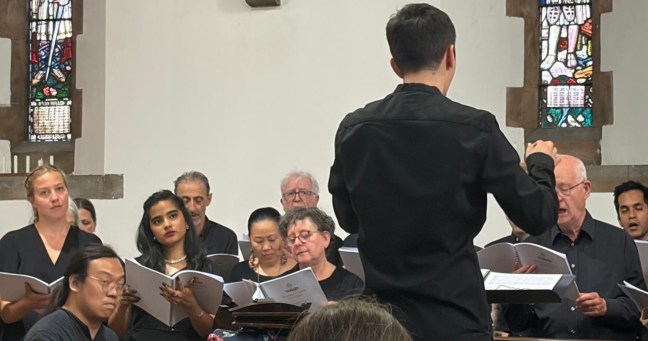
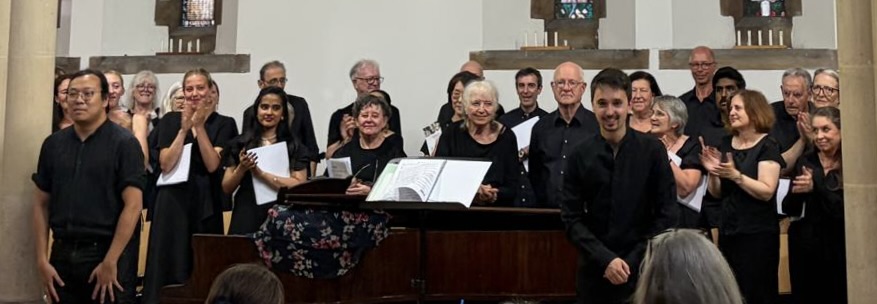
Yesterday, the QPS sang a lovely, pleasingly ambitious programme put together by our conductor Oliver Till, exploring the music of the close-knit trio of Clara and Robert Schumann and Johannes Brahms. The last was represented by his Four Quartets, op 92, composed for piano and four solo voices but often performed by choirs, whereas the Schumanns were represented by lieder (art songs) originally written for single vocalists but here presented in arrangements for choir. Robert’s Widmung was set by Burkhart Schürmann, Clara’s Liebst du um Schönheit by James McCullough; more extensively, two of Clara’s Six Lieder op 13 and all of Robert’s Liederkreis op 39 were arranged by our conductor Ollie, his imaginative, sensitive and deeply satisfying account of the latter song cycle receiving its premiere. If singing that was a pleasure for the whole choir, imagine the feelings of this elderly novice: less than one and a half years after joining the choir (when I would initially sing as quietly as possible in the hope that nobody would hear my mistakes!), here was I loudly singing music never publicly performed before!
Furthermore, since starting with the choir, I’d slowly but surely gained in confidence and had even, foolhardily, volunteered to sing Wehmut, the ninth of the 12 Liederkreis songs, in a semi-chorus of just ten singers: as one of the three basses, my vocal shortcomings would surely be exposed to others to an unprecedented degree. But as it transpired, as with every other challenge encountered since I embarked on the German Requiem in early 2025, any anxiously anticipated obstacles simply vanished into thin air when it came to the concert itself. In rehearsal, Ollie and a few choir members had kindly told me I was doing okay, so that by the time I had to go and stand with the semi-chorus in front of the rest of the choir, nerves were not a problem. I simply had to stick to the score, keep my eyes up on Ollie’s conducting, and sing the same notes and words I’d sung several times before, a little better if possible. After all, Wehmut was hardly an epic undertaking, clocking in at a little under two minutes…

That said, a year ago I’d never have dared to volunteer for such a thing; I mention it here partly in gratitude to the support of my conductor and fellow choristers, partly because I suspect people in choirs everywhere probably have likewise unexpected, challenging but rewarding experiences. It seems to go with the territory. There’s enormous pleasure to be had from singing as part of a shared enterprise, with everyone doing their best to sing in time and harmony with one another; it’s also great getting to know some of those people a little, of course. (Somewhat shy, I confess I could/should have been better at this.)
And then there are the frequent surprises. One such, we discovered at the dress rehearsal yesterday, less than five hours before the audience arrived, was that Daniel Chappell, the pianist and composer who’s our regular repetiteur and who’d worked so hard preparing us for this concert ever since the first rehearsal in late April, was unfortunately stuck in Ljubljana, his flight back to London having been cancelled or some such. Obviously this must have been deeply frustrating for Dan, but disaster was averted for the rest of us when Olllie managed to get his friend and colleague Thomas Ang to stand in as pianist at the last minute. Clearly an excellent musician (he’s recording the complete piano works of Nikolai Medtner, which takes some doing, and is repetiteur for the Royal Ballet), Ang not only provided the choir with superb accompaniment but contributed a delightful surprise addition to the programme by playing another beautiful work by Clara Schumann just before our final song.
As promised above, I won’t keep on writing these pieces after every concert, though I probably will keep trying to persuade friends and others to consider joining a choir – any kind of choir, it doesn’t have to be classical – if they’ve any real interest in music. Queen’s Park Singers is described in its publicity as ‘a friendly choir’, which basically means it’s very open in its welcoming attitude (something reflected in its admirable new policy of providing choral scholarships for young singers – the first two scholars, Sancia and Naveen, were a marvellous addition to the choir over the last year, and sang solos in several concerts including yesterday’s). But I imagine many choirs are ‘friendly’ in that their members probably offer each other support encouragement in the pursuit of creating something enjoyable both to themselves and to others. Certainly, in my own case, being part of the choir, getting to know, sing and love some very special music with others who share my interest, has provided an opportunity – for me, quite rare these days – to grow a little as an individual, intellectually, emotionally, perhaps even spiritually.*
*Almost two weeks after the concert described above, I attended a very enjoyable and illuminating voice workshop organised for the choir, with roughly a third of the members present. To my surprise, I found myself suddenly persuaded by the ‘gentle prodding’ of our instructor/conductor Noah Mosley to join a number of those present who were prepared to perform (very brief) solos. I took an admittedly fairly easy route by singing ‘Shenandoah’; still, even if this was not a paying audience but fellow choir members, it was the first time I’d ever stood up to sing before a large group of people, something I could never have imagined doing even six months previously. It certainly wasn’t a ‘good’ performance, but it wasn’t disastrous, and I’m glad I did it – as, I think, were the others who sang solos. I could hardly have sung for a more sympathetic (empathetic?) audience, and I felt their support. Further proof of the benefits to be had from joining a choir?
Photographs taken at the ‘A Circle of Songs’ concert by Ane Roteta.

