
It was with great sadness that I learned yesterday of the recent death of Tony Rayns, one of the most important, insightful and influential figures in international film culture during the last half-century. For me, as for many others, he was not only a hugely valued colleague but a friend and, to some degree, something of a mentor. He is best known, of course, for playing a crucial part in enhancing the West’s knowledge and understanding of East Asian cinema; even if you’ve never read a word he wrote or have never seen or listened to one of his many superb dvd/BluRay introductions and commentaries, if you’re at all familiar with films from China, Hong Kong, South Korea, Taiwan or Thailand it’s probably in no small degree a consequence of Tony’s passionate and profound engagement with the cinemas of that region. But to categorise him simply as ‘a leading specialist on Asian cinema’ absolutely fails to do him justice. His familiarity with cinema in general was encyclopaedic (moreover, his interests extended well beyond film – he was, for example, an aficionado of bandes dessinnées and graphic novels). Understandably, he sometimes felt a little frustrated at being typecast as the Asian expert.
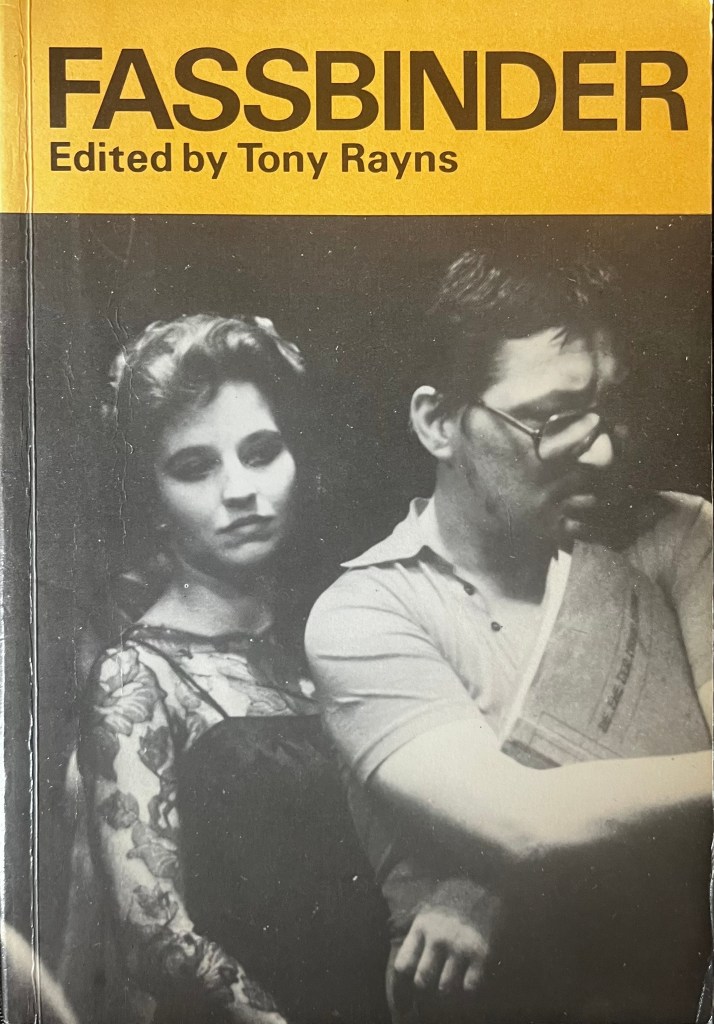
If memory serves, I first consciously became aware of Tony’s name in print in late 1976, a couple of months after my arrival in London; his Time Out review of Derek Jarman’s Sebastiane was so vividly written that it immediately persuaded me to catch that apparently rather ‘niche’ movie on its opening weekend. By then, Tony was already well established as a critic, journalist and all-round cinephile: after leaving Cambridge (where he’d run several film societies), he’d been instrumental in setting up the short-lived magazine Cinema Rising (partly reflecting his interest in avant-garde and underground filmmaking) and been writing regularly for Sight & Sound, Monthly Film Bulletin and Time Out. Indeed, he was regarded as something of an authority on the New German Cinema (he’d edited a very fine BFI monograph on Fassbinder) and on Japanese film (sadly his book on Mizoguchi never came to fruition). But when I first got to know him – he used to come to the Electric Cinema Club occasionally during the years I worked there, and I recall having several very enjoyable conversations with him and his friend Scott Meek during my first and only visit to the Edinburgh Film Festival in 1980 – he was clearly more than happy to share his thoughts on all sorts of cinema. As far as I could see, that never changed. His interest in movies remained all-embracing to the end. (Hence his devotion to the Cinema Ritrovato festival in Bologna, where he had been just before his death.) *
Nineteen-eighty had, however, been a game-changing year for Tony, because it saw the publication of Electric Shadows: 45 Years of Chinese Cinema, a book he and Meek had written to coincide with a substantial, pioneering season – the world’s first retrospective of Chinese film – at the National Film Theatre, which they’d programmed following a trip to the Shanghai studios the previous year. That season certainly put a spin on Tony’s future. Effectively a friend and advisor to directors of the ICA Cinema like Archie Tait, Simon Field and David Sin, he would initially encourage an investigation of the ground-breaking ‘Fifth Generation’ of Chinese directors, most notably Chen Kaige (Yellow Earth),and Tian Zhuangzhuang (The Horse Thief). That was the start of something big: as time passed, because Tony spent so much of his time in the East, and was programme advisor to festivals in London, Rotterdam, Vancouver and elsewhere, he was able to see – and support – early works by the likes of Jia Zhangke, Tsui Hark, Ann Hui, John Woo, Wong Kar-wai, Edward Yang, Hou Hsiao-hsien, Tsai Ming-liang, Hong Sang-soo, Lee Chang-dong, Jang Sun-woo (about whom Tony made a film), Bong Joon-ho, Tran Anh Hung, Kitano Takeshi, Miike Takashi, Otomo Katsuhiro, Apichatpong Weerasethakul… (The list is almost endless, and I’m sure this brief selection of mine omits important names.) On a personal level, that I got to meet some of these filmmakers when I was editing the film pages of Time Out is in no small part due to Tony and the ICA folk; more importantly, both Britain and the world benefitted from Tony’s outstanding work – as a critic, interviewer, filmmaker, programmer, subtitler, translator, explorer and advocate – in bringing these and other filmmakers to our notice. There are not many critics who can be said to have changed or enlarged filmgoers’ viewing habits, but Tony was undoubtedly one of them.
Still, as I said, Tony’s tastes ranged far wider**, as may be gauged from the near-legendary review he wrote in Time Out for a revival at the Electric of Joseph H Lewis’s admittedly marvellous 1955 noir B-movie The Big Combo: ‘Almost certainly the greatest movie ever made,’ began the review, before ending with ‘as heady as amyl nitrate and as compulsive as stamping on insects’.(Tony did confess he might have been tipsy while writing it; no matter, it had the desired effect, producing queues around the block and initiating widespread curiosity about Lewis’s hitherto neglected body of work.) I later had the privilege and pleasure of commissioning and editing Tony, mainly for Time Out but also for a book and for BFI Southbank brochure notes. He always made a point of providing ‘clean’ copy – no errors of fact, spelling, punctuation, grammar or syntax – which would turn out to be typically lucid, incisive, evocative and (only editors will appreciate how important this is) of the precise wordage required: everything one could ask for, in short, but which one seldom receives. For a while I had Tony providing Time Out’s coverage of the films screening on TV; it was a joy reading him on Laurel and Hardy, classic westerns, vintage musicals, British melodramas – material very different from the East Asian films. But I frequently also felt I was learning something. It was thanks to Tony including them in his Sight & Sound Top 10s that I discovered Borzage’s sublime A Farewell to Arms and John Farrow’s thrilling Five Came Back. It was through Tony’s writing that I was introduced to the work of Krzysztof Kieslowski. I recall reading him in the Monthly Film Bulletin on Leone’s Once Upon a Time in America, and feeling it was the most astutely perceptive interpretation of the movie I’d seen. That was an impression I usually experienced on reading his reviews.
It is true that in later years, Tony could occasionally be difficult, insensitive or irascible in his dealings with others; whether this was in any way related to ongoing health issues, or to the vulnerability of having spent his entire life as a freelance, finding work wherever he could, I have no idea. Happily, my own relationship with him remained very pleasant, though sadly I only got to meet up with him once after the pandemic. But I recall our many encounters over more than 45 years with much affection… and gratitude, since he could be warm and generous in sharing his enthusiasms, and supportive and helpful in various ways. When I remember Tony, I usually envisage him with a big smile; he could be great company at lunches, dinners, parties and so on; for all the hard work it involved, he clearly loved his life in film.
I wrote, some months ago, about how the late Peter Howden, my boss at the Electric many years ago, had helped to shape my own professional life. In terms of the critics who had a similar effect, having some sort of influence not only on my tastes in film but on my thoughts about writing, I would place Tony (alongside the likewise great Tom Milne) at the very top of my own personal league. RIP.
* Evidence of Tony’s wide-ranging interest in film can be found in his entries, as one of the youngest contributors, in Richard Roud’s encyclopaedic two-volume Cinema: A Critical Dictionary (1980): he wrote essays on Shirley Clarke, Roger Corman, Philippe Garrel, Mervyn LeRoy… and Hong Kong cinema. When I invited him to contribute a section on international cinema (excluding the US, UK and Europe) for Film: The Critics’ Choice (2001), he chose to write about films from China, Hong Kong, Japan, South Korea and the Philippines, but also Mexico, Turkey, Mali, Iran and India. It is also worth checking out the films he voted for in the Sight & Sound polls each decade from 1982 to 2022 – every time, a different ten.
** I have a vivid memory of bumping into Tony near the National Film Theatre, probably in the late 1990s or early 2000s, and telling him how I’d recently revisited several films by Ingmar Bergman – who had first turned me into a cinephile more than 20 years earlier – having dismissed him for a couple of decades as overly pessimistic and overly arty. ‘Of course,’ agreed Tony with a smile. ‘Bergman is great. I was the same, coming back like a prodigal son after some time away to the films of John Ford.’
I have tried to find a credit for the photo used at the top of this piece, but to no avail. Since it appears to be widely used elsewhere without credits, and it is a good photo, I selected this one.
 notes and observations by Geoff Andrew