I’m not about to explain, once more, my reasons for always wanting to catch any new movie (or any small screen fare, for that matter) by Steven Soderbergh; I already wrote about my enduring interest in his work in posts about Black Bag and Presence and about his low-budget web series Command Z. But that doesn’t mean I’m going to ignore the release of The Christophers – which is not, in fact, the latest film by this ultra-prolific director, since his documentary John Lennon: The Last Interview is ready to premiere at the Cannes Film Festival. (Given Soderbergh’s remarkable output as producer-director-writer-cinematographer-editor – he works in the last two capacities under the pseudonyms Peter Andrews and Mary Ann Bernard – I’m often reminded of a line spoken about Robert Mitchum’s rogue preacher in The Night of the Hunter: ‘Don’t he ever sleep?’)
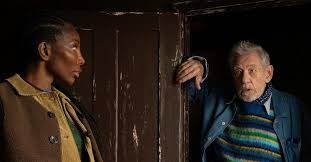
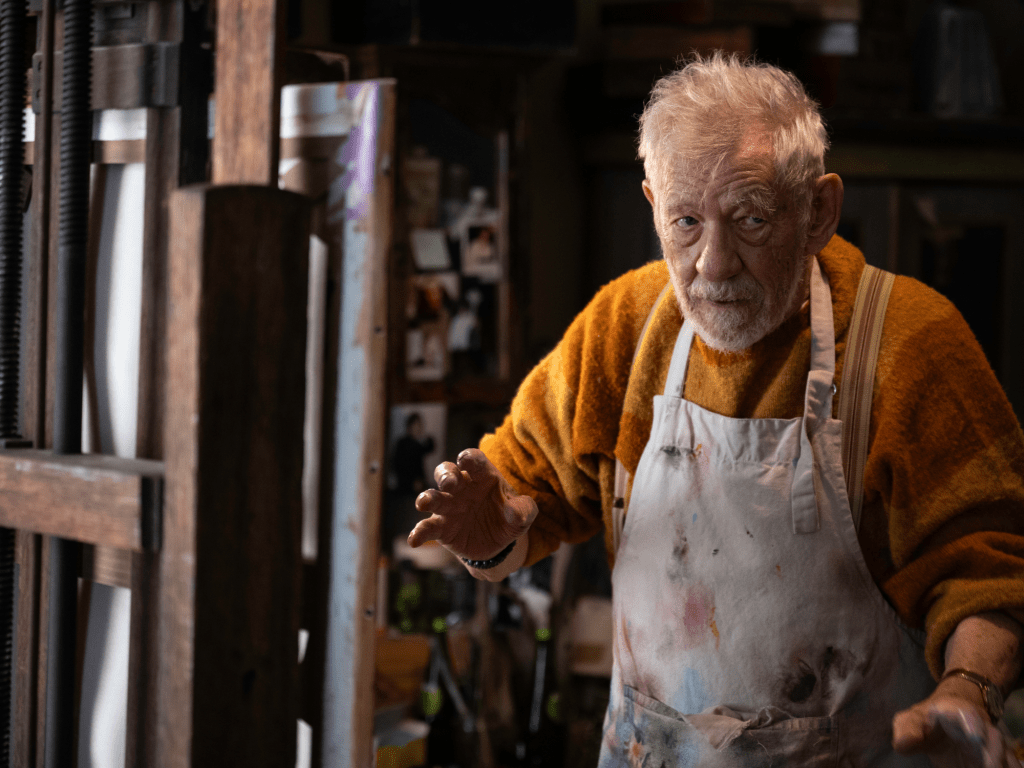
I haven’t seen the Lennon doc yet, but I made a point of going along to the first press screening of The Christophers I was invited to, and I certainly wasn’t disappointed. In many regards it’s essentially a two-hander, with Ian McKellen as Julian Sklar, a reclusive, once lionised painter who’s suffered creative block for years, and Michaela Cole as Lori, an art-restorer persuaded by the artist’s estranged children (James Corden and Jessica Gunning) to take a job as Sklar’s assistant, so that she can secretly finish some famously abandoned paintings (the Christophers of the title) which they can inherit and sell for a fortune after his death. I detest spoilers, so I’ll reveal no more about the plot, which is packed with pleasing surprise twists and turns. What I will say is that, while The Christophers, with its tiny cast, handful of locations (much of the film takes place in Sklar’s credibly cluttered London home) and focus on two central characters, may initially seem ‘small’, it is quite Tardis-like in terms of its thematic wealth, its dramatic sophistication, and its emotional and psychological subtlety. In short, despite its admirably concise running time (100 minutes), it feels very substantial. Moreover, it never feels remotely theatrical: Soderbergh the director, cinematographer and editor has always displayed a firm grasp of what makes good cinema.
There is much to be said, of course, for a good story well told, and the inventive script – by Ed Solomon, who previously worked with Soderbergh on No Sudden Move and the series Mosaic and Full Circle – and the characteristically clear, pacy direction carry us along as if on a rollercoaster, so we never quite know where we’ll be heading next. Plotting apart, the movie touches – lightly, wittily, thought-provokingly – on a wide range of ideas and issues. Given the focus on art (which is handled with unusually persuasive conviction – Solomon and Soderbergh are familiar with painting from first-hand experience), the increasingly complex battle of wits and wills between Sklar and Lori raises plenty of intriguing questions about authenticity and forgery, authorship and identity, creativity and criticism, blockage and impetus. At the same time, parental and filial responsibility, trust and betrayal, truth and falsehood, resentment and revenge, ageing and mortality also get a look in, making for a movie stimulating both intellectually and emotionally.
An American friend lost patience with what seemed to him wholly unsympathetic characters, and left his screening after half an hour. I told him he should probably have stayed to the end, given its brisk running-time, since Sklar and Lori become more interesting and more, well, sympathetic as the film proceeds (though Soderbergh typically steers clear of sentimentality and cop-out feelgood formulae). In this, the movie is helped no end by the performances. Cole is impressively enigmatic, allowing Lori’s mysterious motivations to emerge only slowly from behind her sphinx-like mask of duplicitous pretence, while McKellen is simply superb as Sklar, his arrogance and verbal aggression clearly a consequence of a ferocious ego but also defensive weapons designed to conceal a tangle of insecurities and anxieties. Gunning and Corden are, perhaps inevitably, less nuanced in their brief depictions of greedy scheming but both are well cast and funny – and we all know from real-life examples that the offspring of successful and self-centred artists can have a tough time of it.
In short, Soderbergh and Solomon know what they’re talking about, be it art or life, and it shows: The Christophers is crisp, consistently engrossing, amusing and intelligent entertainment for and about adults. Notwithstanding ingenious plot twists and snappily comic dialogue, it feels honest and true to human behaviour – commodities found even less readily in cinema now than in 1989, when sex, lies and videotape announced the arrival of a promising and distinctive new talent. Famously, Soderbergh responded to his being awarded the Cannes Palme d’Or for that film by saying, half in jest, ’It’s all downhill from here.’ How very wrong he was.
The Christophers is released nationwide in the UK on Friday 15 May.
 notes and observations by Geoff Andrew