It was with considerable sadness that I learned of the death, a few days ago, of the great composer, bandleader, pianist and occasional horn-player Mike Westbrook, just weeks after his 90th birthday. Sadly, I never met him (though I exchanged a few emails with him and his wife Kate during the last couple of years), but I’d often seen him perform and had acquired many albums of his music over the decades since I first heard his jazz-rock band Solid Gold Cadillac way back in 1972.
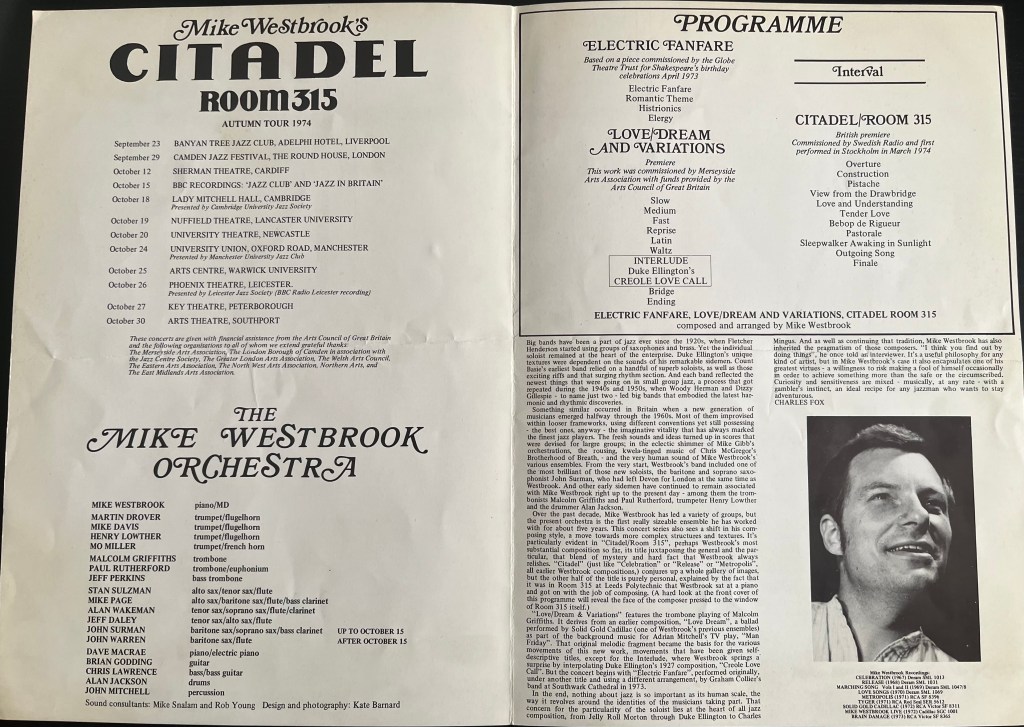
Actually, the teenage Geoff, at that time more into progressive rock than jazz, was quite a late-comer to Westbrook, since Mike had been making a name for himself as a musician of note since the early 60s. I’d seen albums like Celebration and Marching Song advertised on the inner sleeves of my Deram albums by Caravan, Egg and (for my sins) The Moody Blues, but it wasn’t until I encountered the faintly atypical but exhilarating Solid Gold Cadillac that I actually heard any of his music. I enjoyed that album, but the real turning point for me came in October 1975, when I saw Westbrook’s 19-piece orchestra perform the music from the album Citadel/Room 315 (along with Love Dream and Variations) at Cambridge’s Lady Mitchell Hall. By then I was a little more familiar with jazz, and I was blown away by the imaginative variety, textural colours, sheer power and frequent beauty of the music I heard that evening. I not only bought the album in question – quite probably the next day – but set about purchasing second-hand copies of earlier Westbrook records like Metropolis. For me, it was the start of a musical love-affair that has endured to this day.
As it turned out, Citadel/Room 315 was probably something of a turning point for Westbrook, too; while composing that suite, he met Kate Barnard, a painter, singer, composer and writer who would become his second wife and the most important of his regular musical collaborators. They worked closely together ever after on a huge and very diverse range of projects. Besides anything else, song would increasingly become a significant element in the rich array of styles that made up Westbrook’s complex but immediately accessible creative signature.
I’ve already mentioned jazz and rock. While the former was clearly the most important influence on Westbrook’s style – Ellington a particular favourite, as evidenced by the double album On Duke’s Birthday, but one can also discern an interest in any kind of jazz from ragtime to free improvisation – many other genres left their mark. ‘Classical’ of various eras (note the double album Westbrook-Rossini and the solo piano outings with their tantalising echoes of Debussy, Messiaen et al); song of various kinds from pop (including the magnificent Off Abbey Road), blues, calypso, cabaret, music-hall, lieder and chanson to the Great American Songbook, hymns and traditional folk tunes. Poetry features widely, perhaps most memorably in the majestic The Westbrook Blake (which I had the good fortune to see performed live at the Cadogan Hall as recently as November 2021) and in the epic The Cortège (released as a triple album), which takes in Rimbaud, Hesse, Lorca and Clare among others.
Such is the range of Mike and Kate’s interests and ambitions that generic categories simply become meaningless: musical, literary, historical and political inspirations abound, as do instrumental formats, from solo, duet and small ensemble outings to brass band and substantially larger configurations incorporating a full range of winds, strings, keyboards and percussion. The players who have performed Westbrook’s compositions include such stalwarts of the burgeoning 60s/70s British jazz scene as John Surman, Mike Osborne, Alan Skidmore, Alan Wakeman, John Warren, Henry Lowther, Kenny Wheeler, Harry Beckett, Malcolm Griffiths, Harry Miller, Alan Jackson and John Marshall, while later contributors of note include the inimitably versatile Kate, vocalist extraordinaire Phil Minton, saxophonists Chris Biscoe and Pete Whyman, guitarist Brian Godding and accordionist Karen Street. There are others, too many to mention, but such a list demonstrates the appeal, importance and fecundity of Westbrook’s music.
The closing song on the 2024 album Band of Bands – ‘What I Like’ – is joyously evocative of the Westbrooks’ wide-ranging appetite for music and life. With the exception of a few star instrumentalists, no jazz musician, let alone a composer, is likely to achieve great fame and fortune, and certainly Mike Westbrook deserved to be far better known here than he was. (Perhaps unsurprisingly, Europe – the source of many commissions – seems to have shown greater appreciation of the Westbrooks’ work than Britain, a reflection, arguably, of their willingness to draw on poems for compositions that would be sung in the original French, German, Italian, Spanish, Swedish, Finnish or whatever.) The fact remains, however, that Mike Westbrook was, along with the late Graham Collier, an enormously influential force in the development of British jazz; his importance cannot be overestimated. Should you want to learn more about him, read Richard Williams’ excellent Guardian obituary. (You can also find earlier blogs about Westbrook’s music here , here , and here ) All I can add, finally, is that Westbrook’s music has brought me great enjoyment for more than half a century, and I always looked forward to any new release. It’s a great pity there won’t be any more new music, but what a superb legacy Mike left us. RIP.
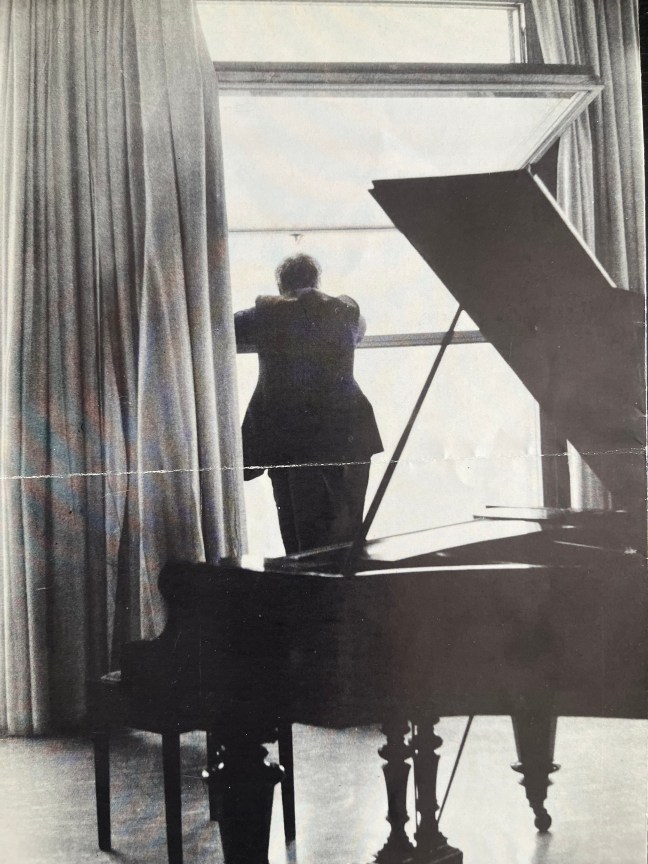
The photo at top, from the programme leaflet for the concert I attended in Cambridge on 18 October 1975, was taken by Kate Barnard, later Kate Westbrook, who also designed the leaflet (see below). You can find out more about the Westbrooks’ work at https://www.westbrookjazz.co.uk/index1.html
 notes and observations by Geoff Andrew
Marvelous tribute.
Your early encounter with Solid Gold Cadillac reminds me: I started young too… My first encounter was a 1970 BBC2 showing of The Original Peter (with Welfare State & Norma Winstone) on TV, went out and bought the single the next day. The following year I heard his music at the NT in Tyger, the fountainhead of the Westbrook Blake & Glad Day (MD was the memorably-named Fiachra Trench who followed this little drama by manning keys on the original cast album of The Rocky Horror Show…) At the end of ’71 I first heard Mike live with the Boyle/Potter/Khan/Jackson quintet heading the bill at the opening of the Jazz Centre Society at St Katharine Dock (along with Keith Tippett Trio & Alexis Korner!); and then, a year or two later, on tour with another Adrian Mitchell play, Man Friday, songs from which are on that 1st Solid Gold Cadillac album. Around 75/6 it was brass band & Goose Sauce time in Basildon, where he often returned, memorably with Mama Chicago in ’79. And since then, I’ve tried to see all iterations of Mike’s marvelous musicians as often as possible, notably a good few orchestras (uncommon or otherwise) and a number of Glad Days, including his final one at Blackheath last year.
I feel honoured to have known him and Kate, and privileged to have been present within frequent earshot of his amazing music.
LikeLike
Sounds as if you saw him/them live enviably more frequently than I, despite my best efforts!
And yes, Fiachra Trench was a memorable name!
LikeLiked by 1 person