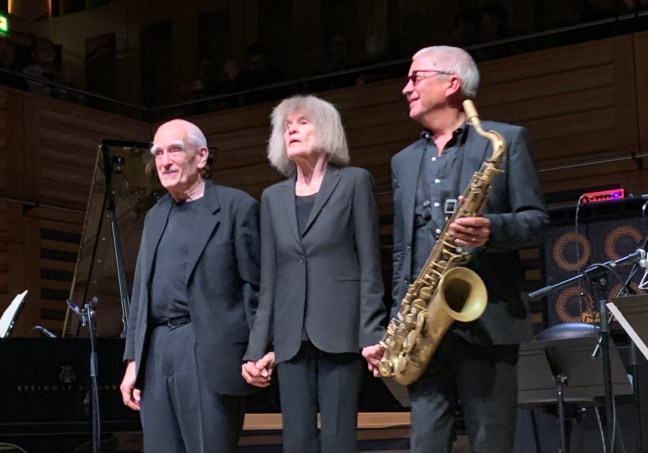
I’ve been listening to some very interesting new music recently (more about which soon-ish, I hope), but nothing has been more welcome than a Carla Bley double CD entitled Joyful Noise – a somewhat unexpected treat since the great bandleader, composer, arranger, keyboards player and occasional singer died around two and a half years ago. (The photograph above, of Bley with Steve Swallow and Andy Sheppard, was taken at the end of the trio’s concert at London’s King’s Place in November 2019.) Fortunately for Bley fans, a recording was recently found of a concert she and her band gave in Hamburg for Norddeutscher Rundfunk (NDR) in March 1984 – a time of transition, according to the liner notes by bassist Steve Swallow, Bley’s partner for many years. She’d been writing for the ten-piece instrumental line-up deployed in Hamburg – trumpet, trombone, French horn, tuba, reeds, organ, piano, electric bass and drums – since the album European Tour 1977, and had continued very fruitfully with that same format on four more albums: Social Studies; the score for Claude Miller’s movie Mortelle Randonée; The Carla Bley Band Live!; and I Hate to Sing. But just six months before the Hamburg gig she’d recorded Heavy Heart with a smaller ensemble reflecting, Swallow says, ‘her connection to Rhythm and Blues’ – and was already developing material for a horn-free sextet, which would perform (admittedly with a little input from winds) on the 1985 release Night-glo. (That album was, for this admirer, perhaps Bley’s least satisfying album; it’s not at all ‘bad’, but the instrumentation lacks the colour and force of much of her finest work.) She would return to writing for larger bands with 1989’s Fleur Carnivore and several subsequent releases, but Joyful Noise is a very welcome addition to her catalogue for many reasons, not least because it lets us hear the ten-piece outfit perform material composed for the smaller group on Heavy Heart. (Another reason is that the album is quite simply a blast from start to finish; as Swallow writes, ‘This is a recording of a very good night… The band is on fire… [It] didn’t party after the gig, it partied on the gig.’)
For some, the most familiar of the dozen numbers – which run for almost two treasurable hours – will probably be The Lord Is Listenin’ to Ya, Hallelujah, a barnstormingly blowsy gospel ballad loudly and gloriously fronted by trombonist Gary Valente, which was deservedly a popular favourite at Bley concerts in the early 80s (I have my own fond memories from the Roundhouse) and which got to feature on the Live! album. The opening number, an account of the traditional tune La Paloma, had been put through numerous variations on the soundtrack for Miller’s film (well worth checking out, by the way; adapted from a Marc Behm crime novel by Michel and Jacques Audiard, it starred Michel Serrault and Isabelle Adjani). Battleship – inspired, Bley reveals in her introduction, by Britain’s scuffle with Argentina over the Falklands! – had appeared on I Hate to Sing. An inventive arrangement of Monk’s Misterioso apart, most of the other numbers played in Germany were, as mentioned above, written for Heavy Heart, but here, performed live by different instrumental forces, the versions are probably without exception stronger in every regard. There are also two tributes to Ellington – the closing Copyright Royalties (released in duet form on the 1993 Bley-Swallow album Go Together, and arguably less homage than a loan) and Venus Fly Trap, which would later become known as Fleur Carnivore on the big-band album of that title. Suffice to say that, as with Battleship, the Hamburg version is often surprisingly different from the later one in the way it ranges through various moods, tempi and styles. Bley never rested on her laurels.
There is one number – the cheekily punning Nu Derection – which, as far as I am aware, is not available elsewhere, and therefore all the more welcome. As with many of the longer tracks – it lasts almost 15 minutes – it does indeed keep changing direction. Kicking off with Victor Lewis’s wild drum solo, it then (p)lunges into a likewise crazed, lopsided calypso overlaid with all manner of dissonant screams, squawks and roars from the brass – controlled chaos – before it seemingly falls apart to reconstitute itself as a (slightly) more conventional big-band take on the same rhythm, something more like a funky shuffle. Then there’s an extended meditative pause with the suspended notes of Mike Mantler’s floating trumpet to the fore (echoes of Ornette’s Skies of America?) until Lewis’s drums and Swallow’s bass insistently urge the ensemble back into a pacy, punchy run that builds to a brief but brilliant climax.
I’ve described this number at some length because it exemplifies both the endless invention of Bley’s writing and the profoundly passionate enthusiasm, energy and expertise of the playing throughout. Mostly Bley regulars, Steve Slagle and Tony Dagradi (saxes), Vincent Chancey (French horn), Bob Stewart (tube), Ted Saunders (piano) and Bley herself (organ) are on a par with those already mentioned, while the sheer musical diversity of the leader’s compositions is extraordinary; now she’s flirting with funk or fusion, now advancing on contemporary ‘classical’, now taking a trip down memory lane with allusive echoes of big-band, bebop, blues or balladry; even revisiting the experimentation of the ‘60s (moments in Battleship may recall Communication, the Jazz Composers Orchestra album Bley and then-husband Mantler released on Fontana back in 1965). Amazingly, this rich musical mix hangs together, coherent from start to finish. Moreover, it’s always very recognisable as music by Carla Bley. For this listener as least, there’s not much higher praise than that.
Carla Bley: Joyful Noise (Live in Hamburg 1984) is released by MiG.

