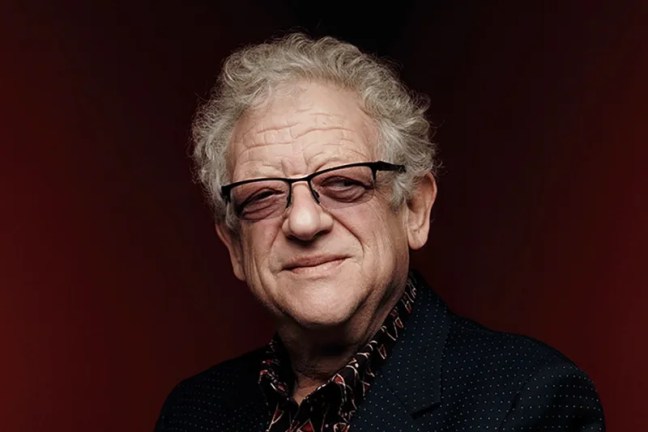
My tardiness in posting a brief tribute to the late, great film producer Jeremy Thomas – who died last Friday, aged 77 – was due not only to the fact that, at the time of his death, I myself was just out of hospital and having to take it easy after a fairly serious operation; another reason was that I was initially unsure whether I even felt like writing something, having already composed four tributes to friends who’d died since the start of 2026. (No more, please…) But then my post-op energy began to return; also, in thinking about when I’d last seen Jeremy, I realised that it was just over two years ago, at the end of August 2024, when he had come along to my leaving do at the NFT, to mark my (involuntary) departure from the BFI when the organisation decided to ‘let me go’ after a quarter-century of heading up or being involved in the programming of that venue. Jeremy had been kind enough to turn up to see me off, so I thought it only fair that I should at least put together a few words to mark his own departure from our realm.
This is not the place to list in any detail Jeremy’s extraordinary CV as a producer, collaborating in remarkably fruitful relationships with Bernardo Bertolucci, Nicolas Roeg, Nagisa Oshima, David Cronenberg, Takashi Miike, Terry Gilliam, Matteo Garrone and numerous other directors of ambition and talent; you can read proper obituaries elsewhere. This, rather, is a personal remembrance, not of someone I could ever claim to have known well, but someone I knew for almost four decades; someone, more importantly, whom I also liked, respected and always got on well with.
It might have turned out differently. If memory serves (and it still does, just about), the first time I met Jeremy was at a Groucho Club party marking the release of Wim Wenders’ Wings of Desire. (Jeremy’s company Recorded Releasing was the film’s UK distributor.) It was a fairly starry gathering, but the main thing I now remember was that Tony Rayns had introduced me to Jeremy and Bertolucci; while I stood chatting with them, someone walking behind me knocked my elbow, with the result that my glass of red wine spilt over both Bernardo and Jeremy. This being our first encounter, I didn’t yet know that his calm, extraordinarily amiable response to this regrettable accident was very characteristic of his unusually personable behaviour. (How else could he have got so many… well, ‘difficult’ films made? Though he never regarded them as such, of course: he just wanted to make films he liked the sound of.)
I met Jeremy a great many times thereafter, and he was always charming, friendly, generous with his time – and completely fair. He was chairman of the BFI from 1992 to 1997, years when, under the pseudonym Waldo Lydecker, I would frequently use my film gossip/news column in Time Out to question and criticise the policies of the organisation’s Director, Wilf Stevenson. Like most film folk (Stevenson included), Jeremy knew perfectly well that I was Waldo, but he never uttered a word of complaint about my coverage of the BFI. Likewise, there were films he produced which I reviewed unfavourably, but he never seemed to let that affect our relationship; as far as I could tell, what mattered to him – as it did to me – was not my critical response to specific films, but our shared cinephile enthusiasm for a particular kind of cinema: a vision of film not just as profit-seeking industrial practice but as an artform with enormously expressive potential. It’s precisely that vision – and its enduring strength – that made Jeremy not only one of the greatest producers of recent times, but an important and inspirational figure in international film culture.
To some extent, Jeremy was ‘film royalty’. Famously, his father Ralph and uncle Gerald were successful directors, and he grew up surrounded by movie people; fairly early on in his producing career, he established himself as a significant force in the British (and international) film world. Yet I’m sure I’m not alone in thinking that he never came across as grand, entitled, overweening, overbearing or self-important. (He regarded Ken Loach, for whom he had worked as assistant editor, as something of a mentor, which is perhaps not irrelevant.) Indeed, in all my own dealings with him, Jeremy struck me as unfailingly modest, down to earth, practical, friendly, sensitive, amusing and seriously intelligent… in a word, human. A mensch. Those qualities, I hope, are evident in this video, when I had the privilege of interviewing him on the NFT stage during a short season of his films I’d put together in 2014. (You can also check out this print interview, conducted with him around the same time, by my friend Nick James, then editor of Sight and Sound.) Here was a man without airs, who knew what he liked, and who surely understood rather more about film and the world than he would ever let on. RIP.
Photo at top courtesy Variety.
 notes and observations by Geoff Andrew