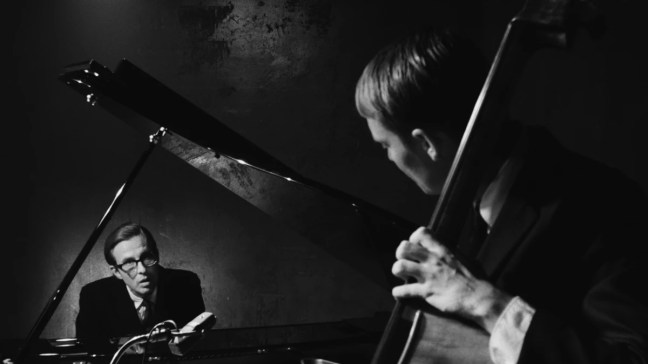
Good movies about jazz or set in the jazz milieu are far from common, so if you’ve any interest in the musical form – or, needless to say, if you’re a fan of the titular pianist – you should certainly make an effort to catch Everybody Digs Bill Evans. Not that you need to love jazz to enjoy Grant Gee’s film – actually, there’s not much of Evans’ music in the movie – since it succeeds perfectly well as an incisive, insightful study of familial relationships, of psychological trauma and healing, and of creative block. But it helps if you do like jazz, of course, since one of the many pleasures the film affords is that, in terms of its presentation of Evans’ music and the world in which it was created, it gets things admirably right.
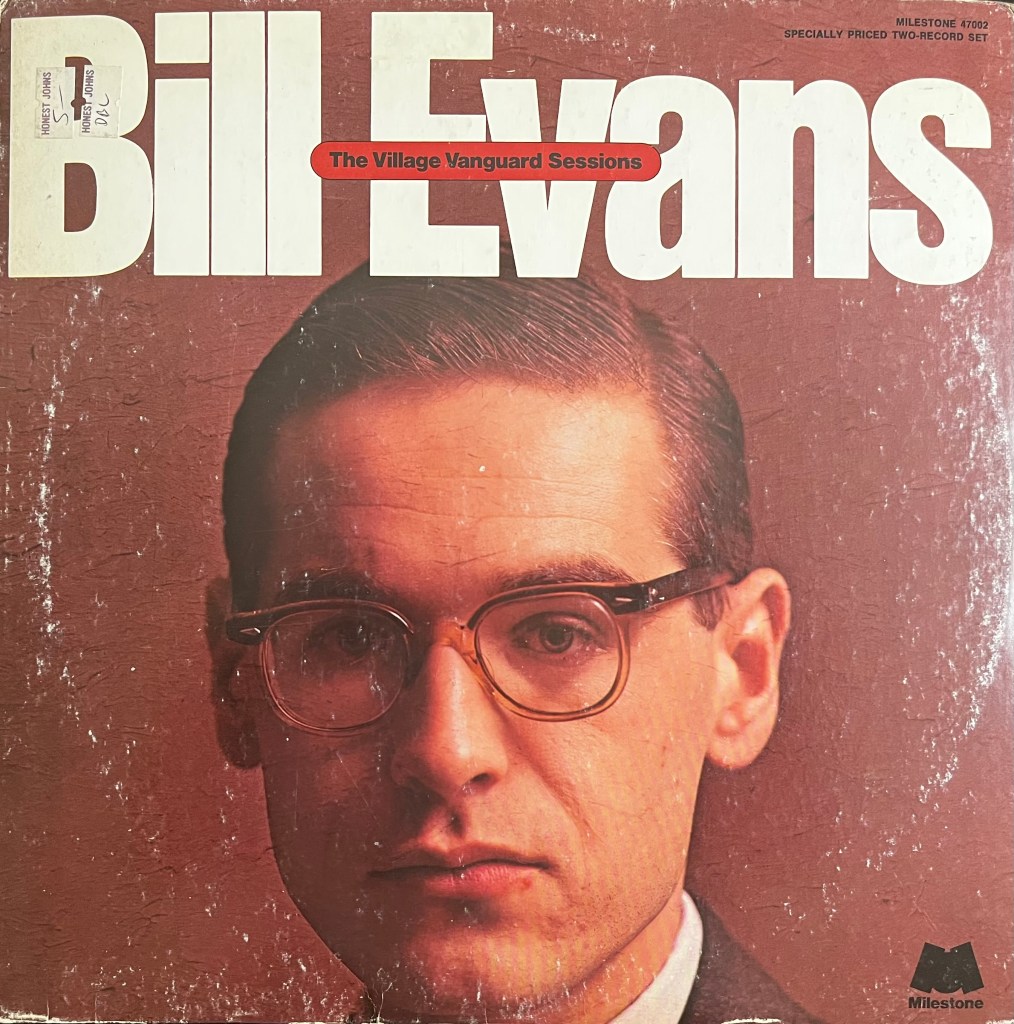
Adapted by Gee and scriptwriter Mark O’Halloran from Owen Martell’s novel ‘Intermission’, the film focuses on the problematic period in the pianist’s life following the death in a car crash of Scott Le Faro, the brilliant bassist in the pioneering trio Evans formed with Le Faro and drummer Paul Motian. We see these three playing ‘Gloria’s Step’ together at the Village Vanguard on 25 June 1961 – a live session, a mere ten days before the fatal accident, which was fortunately recorded and released – at the very start of the movie; thereafter, performance takes a back seat, since Evans’ initial response to the loss of the man he regarded as a musical soulmate was to abandon his instrument and take increasingly frequent refuge in his heroin habit. Eventually, his music-teacher brother who offers him company and accommodation until he’s ready to play again – feaful especially about the potential effects of the addict’s chaotic behaviour on his young daughter (dedicatee of Evans’ lovely tune ‘Waltz for Debbie’) – insists he move out and take up residence with their parents, now retired in Florida. They, inevitably, are more strait-laced than their famous son, but that doesn’t mean that they can’t offer help in their own strikingly different ways.
No need to go into further details about the storyline; I detest spoilers, and anyway, the various riches offered by the movie are to be found in subtle narrative details and in the bold assurance of the execution. I’ve seen little of Gee’s work – I was disappointed by Patience: After Sebald, but impressed by his collaboration with Orhan Pamuk on Innocence of Memories – but clearly he is unafraid of challenging material, and that works well in his favour here. A mostly linear narrative is occasionally and evocatively interrupted by expressionistic inserts suggestive of the protagonist’s junk-fuelled inner life and by flashforward sequences showing key moments from Evans’ later years; meanwhile, brief shots from Pennebaker’s Daybreak Express are intercut to offer authentic glimpses of postwar New York. Piers’ McGrail’s cinematography – black and white for the main story, drenched colour for the flashforwards – is arguably a little too Herman Leonard in its deployment of moody high contrast in the early scenes, but soon settles down for something less insistently stylish, coming into its own in the Florida section. The art direction and production design are spot-on, while Roger Goula’s subtle score is extremely effective. The performances, meanwhile, are uniformly excellent, perhaps most memorable the sterling work by Laurie Metcalf, Bill Pullman and Barry Ward as Evans’ mother, father and brother.

Then there is Anders Danielsen Lie as Evans. It’s an immensely persuasive performance, vividly conveying the pianist’s pain, confusion, frustration and sense of alienation after Le Faro’s death. It’s here, I think, that my one significant reservation about the film lies. It has nothing at all to do with the Norwegian actor’s superb work, and everything to do with the basic conception of the narrative, which focuses almost exclusively on this period of numbed withdrawal in Evans’ life. Consequently, we are never allowed any insight into the man’s character, which is presented throughout as consistently reticent and passive. Evans was not only a wonderful pianist but a major creative force, who worked with Miles Davis on Kind of Blue and whose work influenced the likes of Paul Bley, Keith Jarrett and Chick Corea, not to mention countless pianists and trios who followed. What we get to see in the film is a gentle, tormented, eroded soul seemingly devoid of personality and purpose, let alone charisma. But there must surely have been more to Evans than that; the film shows the shadow of a man, but we never get to glimpse the man himself.
Perhaps, that is to ask for a slightly different film, though it might have been illuminating to have something more positive on offer, however briefly, to compare with the hollowed-out wreck here, who is placed centre stage but is little but a receptacle for the words and actions of others trying for the most part to help him. Whatever, this is a minor reservation others may well not agree with; certainly it shouldn’t for a moment put you off going to see an extremely fine piece of work. After all, almost everyone who’s already seen it digs this Bill Evans movie.
Everyone Digs Bill Evans is currently on release in UK cinemas.
 notes and observations by Geoff Andrew