
If you’re tired of superhero fantasies (and yes, I do include Nolan’s The Odyssey) and often disappointed by what now seems to pass for a substantial art-movie – think Almodóvar’s elegant, intelligent but rather lifelessly academic Bitter Christmas or Anna Cazenave Cambet’s heartfelt but underwritten and cliché-fraught Love Me Tender, neither of which moved me one jot – you might consider checking out Late Fame, a genuinely lovely little picture which never once feels false or formulaic, so blissfully unconcerned is it with fashion, fads or generic expectations. The second fiction feature by Kent Jones – eminent critic, former director of the New York Film Festival, long-term associate of Martin Scorsese (with whom he made several documentaries)* – it is notable not only for a superb performance by Willem Dafoe, but for its unostentatious honesty and quiet humanity, both quite rare in most of the movies made these days.
I say ‘lovely little picture’ because the modesty underpinning every aspect of Late Fame is an essential part of its charm, its tone and its meaning; as with Jones’ underrated first feature Diane, nothing is overstated, overwrought, over-extended. (It runs, by the way, a throughly engaging 96 minutes.) Despite the setting in contemporary New York, the film was imaginatively adapted from a novella by Viennese writer Arthur Schnitzler (now surely best known for the works turned into Max Ophuls’ La Ronde and Kubrick’s Eyes Wide Shut) by Samy Burch; she also scripted Todd Haynes’ impressive May December and Dave Green’s Coyote vs Acme – the funniest film I’ve seen in some years – so is evidently someone to watch. Not that Late Fame resembles those earlier Schnitzler adaptations; rather, it feels, if anything, like something made during those memorably fertile years from the late 60s to the early 80s, the ‘New Hollywood’ now frequently characterised as a second golden age of American cinema. Perhaps that’s not so surprising: Jones, already a cinephile, first arrived in New York City in 1980, and his film explicitly harks back to that earlier era, given that Dafoe’s protagonist, Ed Saxberger, now living a pleasant if unremarkable life as a post-office worker, once dreamed of becoming a poet; indeed, he even had a slim volume of verse published, now long forgotten – not least, perhaps, by himself.
Or so Ed believes, until one day he returns from work to find, standing patiently opposite the steps to his apartment, a nervily confident young man called Meyers, who is not only familiar with Ed’s book of poems but considers it a work of genius. He’s keen to introduce Ed to his friends in The Enthusiasm Society – young Turks with literary and dramatic ambitions of their own – but the older man is understandably wary, not having penned a line for decades. Still, it’s nice to be appreciated, so he eventually goes along, and is taken aback by their admiration, by their eagerness to hear about his experiences among the SoHo poets half a century ago, and by a strange, emphatically theatrical creature of indeterminate age named Gloria – apparently the only woman in the otherwise comfortably-off, college-educated group, and a mascot or mentor of sorts. Though Ed – his hitherto secret life as a versifier apart – is as down-to-earth as the pool-hall friends he regularly drinks with, he can’t help wondering whether his encounter with the Enthusiasts offers a belated opportunity to turn his life around a little, be it in terms of celebrity, sex or simply refocusing his attention somehow.
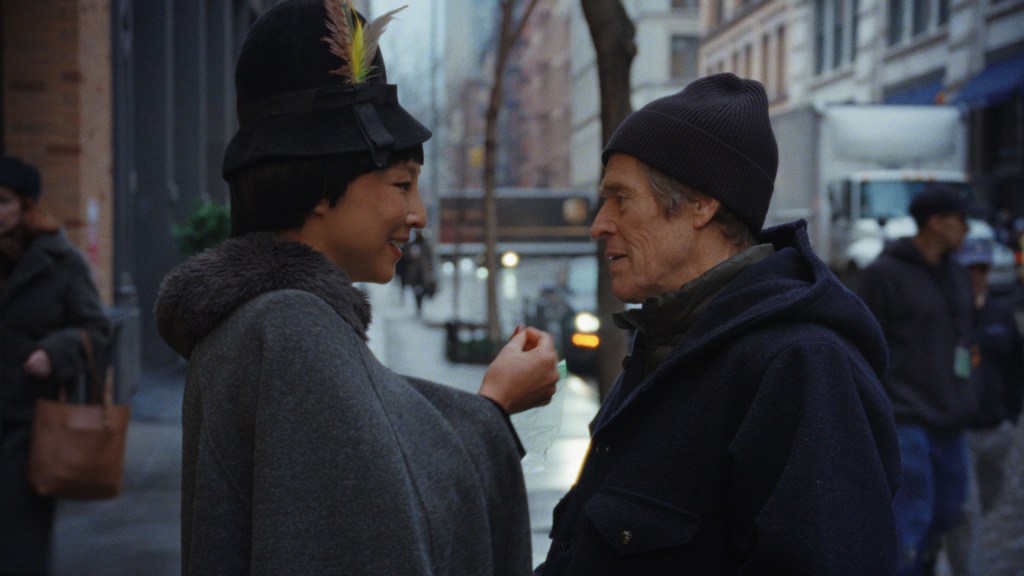
One should not and need not make grandiose claims for a modestly budgeted film with a small cast playing fairly ‘ordinary’ people doing… well, not that much really. (If the rich NYU kids in the Enthusiasts are as naive, pretentious and self-regarding as the preppies in Metropolitan and The Last Days of Disco, they remain just as plausible and finally deserving of our sympathetic attention as Stillman’s characters.) It is a movie about creativity and ambition, idealism and delusion, desire and disenchantment; about youth, ageing, loss, dreams and memories; class, money, friendship, a need to belong and to be oneself. Subjects of no little importance, but treated with the lightest of touches. There’s plenty of humour, but it’s always gentle; there’s an awareness both of life’s harsh realities and its many absurdities, but there’s also generosity, warmth, delicacy. Who needs loud spectacle when we have the mysteries of the human face? Who needs clever meta-narratives or earnest moralising when we have the wondrously fascinating flaws, complexities and contradictions of everyday human behaviour? There are terrific performances here: Dafoe at his very best especially, but Greta Lee’s Gloria and Edmund Donovan’s Meyers are also standouts from a uniformly fine cast. But perhaps what makes the film work so persuasive and pleasurable is that Jones clearly has a deep understanding of the world he’s depicting: not just the people and the places they inhabit, but the poetry itself. When we finally get to hear one of Ed’s verses, along with everything else in this small, unsentimental but big-hearted film, it rings beautifully true.
Late Fame plays in UK cinemas from Friday 4 September.
* Having worked in the same profession, I have known Jones for some years, but I really don’t believe that has influenced my response to this film.

