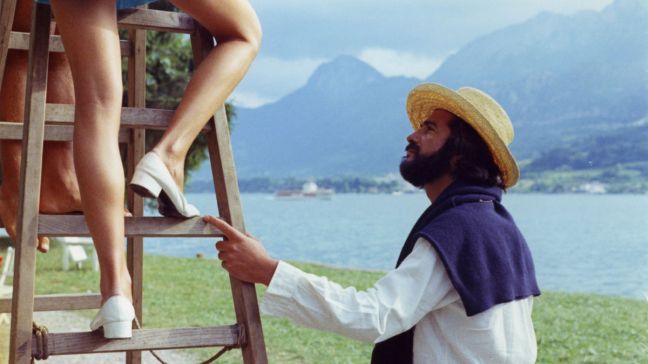
I may not have written here before about Éric Rohmer, but anyone familiar with my writings for Time Out and Sight & Sound or my programming for the BFI will probably be aware that I’ve long held the late, great French writer-director in especially high esteem. Indeed, for two or three decades, until his death in 2010, I considered him one of the very greatest living filmmakers.* There were always some, of course, who would dismiss the work of the man famous for Claire’s Knee (photo at top), My Night with Maud, The Green Ray and An Autumn Tale as somehow ‘uncinematic’, memorable only for its focus on ‘talking heads’. While it’s true that his films often included scenes centred on conversation, there was always far, far more to it than that. For one thing, the talk was great: witty, subtle and unusually illuminating, because Rohmer understood that there was always a gap between what we say and what we feel, think or mean, because we all at times tend to be economical with ‘the truth’ in projecting our self-image – not least in what prefer to tell ourselves. For another, to focus exclusively on the dialogue in Rohmer’s work is to ignore the importance he attached to composition, movement, location, design, colour, montage, etc, as eloquent tools of expression. The eldest of the cinephiles-turned-Cahiers-critics-turned-auteurs who constituted the vanguard of the nouvelle vague, he created an extraordinarily coherent and consistent body of work, as radical, idiosyncratic and intellectually sophisticated in its own way as that of his friend, colleague and occasional collaborator, Jean-Luc Godard. He remained true to the initial ideals of the New Wave, and created a highly personal cinema as distinctive, both thematically and stylistically, as that of Yasujiro Ozu or Alfred Hitchcock (he had famously co-authored, with Claude Chabrol, the first serious extensive study of the latter’s work).
Should you wish to learn more about the mysterious monsieur Rohmer, I wrote at some length about the intriguing relationship between the man – real name Maurice Schérer – and his prolific, surprisingly diverse body of work in a 2015 Sight & Sound article entitled ‘The Double Life of Éric Rohmer’. One of several things I discovered in researching that feature was that he had made a feature film, Les Petites Filles modèles, as early as 1952 (i.e. six years before Chabrol’s Le Beau Serge, often hailed as the first New Wave feature, and three years before Agnès Varda’s La Pointe Courte, cited by some as the most important antecedent of the movies by the Cahiers du cinéma gang). Godard and Jacques Rivette were involved in the shooting of that film, and it’s fair to say it would probably have constituted the feature debut of the nouvelle vague; sadly, the producer withdrew funding before Rohmer could complete the movie. Unfortunately, the material filmed is long lost, while Rohmer, understandably unhappy about the experience and anyway often given to secrecy, wiped the project from his CV, never mentioning it in later years.
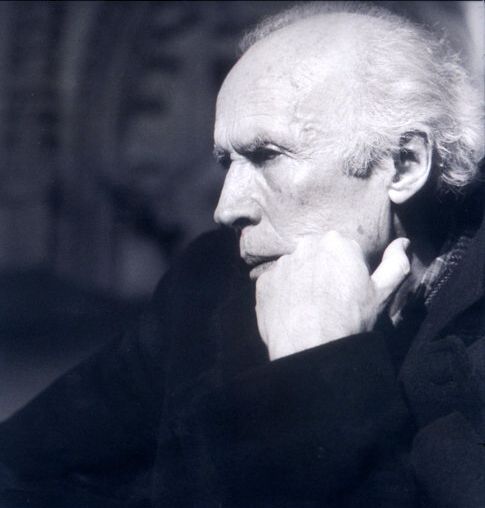
Though Les Petites Filles modèles was an adaption of a book by the Comtesse de Ségur, we shall never know what the film would have been like; we do know, however, that it wasn’t the former teacher’s first foray into fiction. In 1946 he had already written a novel, Élisabeth, under (naturally!) a pseudonym, Gilbert Cordier; it was published by the prestigious Éditions Gallimard, but sold poorly, and effectively disappeared until 2007, when the publishing house reissued it along with a brief interview with Rohmer, who had re-read it for the first time since its original release. Now, at last, the book is available in English, translated by Aaron Kerner, an American academic. (A few colloquialisms struck me as regrettable, but for the most part the English reads well.)
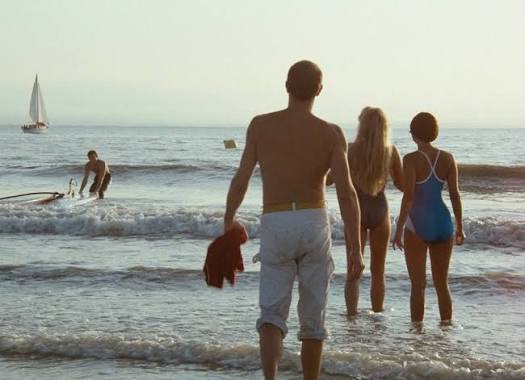
While Élisabeth is certainly no literary masterpiece – though it is fairly impressive as a first novel by a 26-year-old – it is undoubtedly fascinating and revelatory in the way it both foreshadows and differs from Rohmer’s later work as a filmmaker. Though set in the summer of 1939 – and written, according to its author, during the Liberation of Paris when bullets were flying ‘right past my window’ – any awareness, on the part of the characters, of the events that would lead to the imminent war is touched on only briefly. At the time of writing, Rohmer, who towards the end of his career would deal very effectively with violent conflict in The Lady and the Duke and Triple Agent, deemed it impossible to write about the turmoil he had been experiencing; he felt the need to ‘take a step back’. Hence the decision to set Élisabeth some months before the war with most of the characters whiling away their time on holiday, near the Marne estuary. They meet, eat, drive, swim, sunbathe, walk and talk – all, as it would later transpire, typically Rohmerian, as are the vacillations between philosophising and flirtation, and the sometimes almost risibly earnest attempts at self-analysis. There are moments that inevitably remind one of Claire’s Knee, The Aviator’s Wife, Pauline at the Beach, or Boyfriends and Girlfriends. And yet…
Setting aside the fact that Rohmer had yet to attain the assured mastery of characterisation, dialogue, atmosphere and narrative structure that would distinguish his films from The Sign of the Lion onwards, it is also immediately obvious, from the opening pages, that he was actually aiming at something rather different in this novel, which is altogether more enigmatic, more brazenly (i.e. less subtly) ambiguous, more ‘modern’ – to use Rohmer’s own term – than the films which followed. It was written, after all, around the same time as the early novels of Duras, and Rohmer admitted to the influence of Gide, Faulkner and Dos Passos. His extensive use of the third person singular pronoun (‘he’ or ‘she’) means that we are often unsure for a while exactly who he is writing about, let alone how that person might be related to the people he is in company with. Élisabeth was written too early to be a nouveau roman, but it does display an interest in narrative experimentation that is quite at odds with the peculiarly Rohmerian form of classicism to be found in the films.
One other aspect of the novel may come as a surprise, given Rohmer’s reputation, among his detractors, for focusing excessively on dialogue. There are many extensive passages of detailed description, particularly of place – of topography, vegetation, architecture, colour, light, shade, weather – but also of clothes, hair, faces, limbs, gestures, glances. Still, isn’t this indicative of the attention he would pay to such elements in his films? He thought of cinema as an artform profoundly defined by the expressive articulation of space; moreover, he not only wrote and directed his films, but very specifically chose the locations, cast members, set designs, music and so forth himself. He knew precisely how his films should look, sound, feel. This for him was filmmaking. Talking heads? Talking everything, more like…
Élisabeth is not an amazing read, then, but it is an interesting one. And if you’ve any long-term interest in the slightly strange but surely brilliant man who made some of the finest films of the second half of the twentieth century – for me, at least, Rohmer made around eight or nine films which might be called masterpieces – then you might consider checking the book out.

* Finally, one other quick film-book tip for those who, like me, rated Abbas Kiarostami as another truly great filmmaker of recent times. I’m usually none too keen on determinedly academic studies of films and filmmakers, but I discovered an exception in Hossein Khosrowhjah’s Abbas Kiarostami and Iranian National Cinema, recently published in paperback. The writing is just occasionally a touch jargonistic (and here and there simply clumsy in its syntax), but for the most part it’s lucid enough and there are insightful readings of Taste of Cherry and The Wind Will Carry Us. (Khosrowhjah’s brief consideration of 10 is also of merit, even though he clearly hasn’t read my own more detailed monograph on that film!) But what is really valuable and welcome is his detailed and very effective demolition of the illogical, seemingly politically motivated complaints made by expatriate Iranian writers like Hamid Dabashi and Azadeh Farahmand that Kiarostami was misrepresenting Iranian society and culture with the intention of impressing, flattering and winning over Western viewers. Anyone who’s seen the aforementioned films, let alone Kiarostami’s even more audacious and eccentric later works, should know he wasn’t exactly courting widespread acclaim, but his success appears to have provoked all manner of resentment in many of his compatriots, be they in Iran or abroad. Sad…
Éric Rohmer’s Élisabeth is published by McNally Editions and available in paperback or on Kindle. Hossein Khosrowhjah’s Abbas Kiarostami and Iranian National Cinema is published by Bloomsbury.

