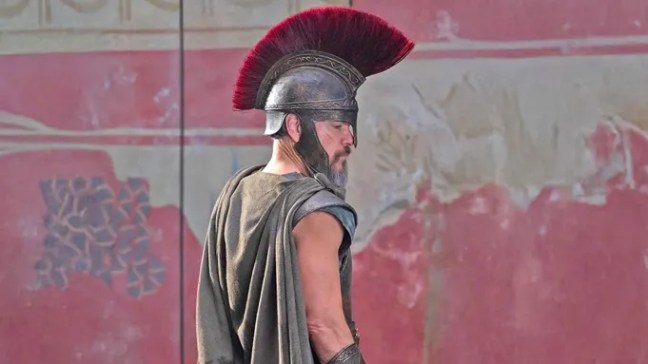
There’s been a great deal of discussion about Christopher Nolan’s The Odyssey, so why shouldn’t I join the fray?
While I like to keep an open mind before I see a movie, in this case I suspected I’d be a sympathetic viewer, since Nolan is one of the relatively few directors working in the American film industry I try to keep up with. (I know he’s British, but he wouldn’t be able to make his megabudget movies without the American studio machine.) I was – if only because its European premiere at the Rotterdam Film Festival took place after most other Brits had returned home – the first UK critic to review Following; I followed that with an interview with Nolan about his debut for Time Out, and then with one onstage at the NFT for Insomnia. I was impressed by most of what followed, notwithstanding my lifelong apathy concerning Batman; disappointed by Dunkirk, I missed Tenet, but mostly enjoyed Oppenheimer, even if it confirmed once and for all that Nolan is not adept at sustaining the kind of extended scene which requires nuanced emotional, psychological, ethical or even tonal shifts: his way of structuring a film – and, perhaps, of thinking about time and characterisation – is too fragmented for that. Still, he’s a major talent, and one of the most boldly ambitious filmmakers working in America today.
Then, too, there is Homer. Studying Classics to degree level, I read The Iliad and The Odyssey in the Greek, and loved them. But that was half a century ago. In the intervening years, I read The Odyssey again, but in translation. For my 70th birthday, not only did a friend give me Emily Wilson’s excellent translation of The Iliad but two others gave me books about Homer and the Homeric world. Theories about the genesis of the two poems have developed intriguingly in the last 50 years, so I read them with fascination.
With fascination, but also with woefully dim recall of the original texts.* So my take on Nolan’s version of Homer’s epic is emphatically not that of an expert. I haven’t bothered reading much of what’s been written about the movie; too often, what now passes for criticism tends towards extremes, raving about a must-see masterpiece or lamenting a misbegotten bore, whereas most films surely lie somewhere in-between. For me, then, Nolan’s The Odyssey is impressive but also – perhaps inevitably – frustrating.
A few impressions and thoughts…
First, accuracy and fidelity. The film is an adaptation of Homer, but The Odyssey as it has come down to us is itself an adaptation of sorts, a written transposition of oral poetry performed (and transformed) by rhapsodes in pre-literate society over several centuries: poetry recounting tales set centuries earlier, about quite probably fictional characters (mortal and divine) involved in probably fictional events taking place in often fictional locations. Criticisms of the film’s ‘historical accuracy’ are therefore to some degree irrelevant, though clearly some effort should be made to make the architecture, costumes, behaviour, dialogue, etc, persuasive. It also helps to observe some fidelity to the text; after all, The Odyssey and The Iliad are inarguably very great works of literature, as deserving of respect as the Bible – or, indeed, anything else. Nolan appears to have taken this on board; that said, I’m far from sure that, in his desire to make the film (a) entertaining for the global audience, and (b) ‘relevant’ to contemporary concerns, he has produced anything more rewarding than a technically ambitious, mostly engrossing, well-mounted action spectacular.
So yes, I enjoyed the film, but with substantial reservations. I suppose my doubts arose with the first appearance of the Trojan horse, half-buried in the sand like the Statue of Liberty at the end of Planet of the Apes – visually striking, for sure, but also introducing a level of implausibility. How and why would it be left in such a position? Wouldn’t it make it still more unlikely that the Trojans, already suspicions of Greeks bearing gifts, would dig it out of the sand and drag the enormous thing into their besieged city? Another early minor problem for me was Athene: given that the other deities have been removed from the dramatis personae and are represented by natural forces, why do we see and hear Athene in conversation with Telemachos? I sometimes got the impression that she was not so much a goddess as some sort of imaginary special childhood friend.
As an introductory title explains, what is depicted was a time of ‘apparent magic’, which might be seen as a means of sweeping any implausibilities under the carpet. At the very least, it serves to explain the existence of such strange and supernatural beings as the cyclops Polyphemus, the Laestrygonian giants, the sorceress Circe, the monster Scylla and the nymph Calypso (though, as incarnated by Charlize Theron, the last doesn’t appear to be especially divine or even a devious seductress, merely an attractive and very helpfully supportive friend – a good listener, in short). In terms of visual effects, Nolan executes most of Odysseus’ fabled encounters with these mythical figures with considerable technical panache, though I confess that the episode featuring the Laestrygonians reminded me – quite irrationally and very unfortunately – of Monty Python and the Holy Grail: I half-expected one of the heavily armoured cannibals to suddenly say ‘Ni!’ Time and again, in fact, I was reminded not so much of Homer’s original as of other movie characters: a mute and menacing Agamemnon, in particular, channeling Darth Vader.
The Odyssey is a long, complex poem, and it’s understandable that Nolan omitted certain characters and episodes, though it’s a shame we got only one cyclops and didn’t get Homer’s ‘My name is Nobody’ plot twist, which memorably exemplifies Odysseus’ renowned cunning and wit. Indeed, there is scant evidence of the hero’s capacity for trickery and ingenuity. As conceived by Nolan and embodied by an earnest Matt Damon, Odysseus comes over as a well-meaning if intellectually not so smart super-athlete. Vivid characterisation is not the film’s forte (only Robert Pattinson’s Antinous and Samantha Morton’s Circe – not exactly the braided beauty of the original – make any real mark); and it could be argued that the women, with the possible exception of Anne Hathaway’s Penelope, are given short shrift, being rather less robust and charismatic than their literary counterparts. The potentially fruitful casting of Lupita Nyong’o as both Helen and Clytemnestra is utterly wasted by giving each character so little to do or say.
Perhaps she got off lightly. It’s one thing having the characters speak modern English in American accents; it’s quite another having Telemachos repeatedly referring to his missing, supposedly godlike parent as ‘my dad’. (Wouldn’t ‘father’ have been better?) The script, by Nolan himself, is a queasy mix of contemporary demotic (including the odd ‘fuck’) – though mercifully no-one gets to bid farewell by saying ‘Later…’ – and the kind of highfalutin’ pomp we’ve always known and loved (and laughed at?) in Hollywood epics. There are also regrettable allusions to ‘our age of bronze’, as if those living through the Mycenaean era were prescient as to how they’d be categorised by historians three millennia later.
Cinematic epics have long been known for grandiose pomp, and Nolan’s film, for all its tin-ear deployment of modern conversational tropes, is no exception. Moreover, as in the heyday of the Hollywood epic – the 50s and early 60s, when films about the Roman Empire were often littered with Cold War analogies – Nolan has tried to make a movie about the Homeric universe which is somehow ‘for’ or even ‘about’ today. Agamemnon’s devotion to the attack on Troy is several times mentioned in connection with trade routes. As far as I recall, the word ‘slave’ is not used – despite slavery being an integral part of the ancient world – having been replaced by ‘servant’, which means something quite different. Mention is made of ‘peoples from the sea’ and the need to adhere to ‘Zeus’ law’ – an invention referring to the importance attached in the Greek world to observing respectful rites of hospitality towards others, strangers and foreigners (xenoi) included – which is clearly meant to reflect on contemporary concerns about migration. The trouble is, all this ‘relevance’ feels gratuitously imposed – or, worse, quite illogical in the context of the world created on screen.**
The most obvious example of trying to impose today’s values on to a society whose mores were very different from our own arises in the ‘narrative arc’ provided for Odysseus, a psychologically undernourished, fairly colourless character compared to his literary antecedent. We are asked to believe that he is horrified by the carnage unleashed after he and the other Greeks concealed within the Trojan horse – his own cunning ruse – emerge to let the army enter and overrun the city. Recalling this, when Calypso allows him to regain his memory after seven years of lotus-induced bliss, he suffers enormous guilt and regret. Nolan’s introduction of this plot-twist is unfortunate in several respects. Transplanting on to Odysseus a modern sensibility which is entirely at odds with the ethos of the ancient world not only turns the character into a cultural anomaly, but makes no dramatic sense: why would Odysseus stare as if in a state of bewildered shock at the deadly conflict all around him as the Greeks slaughter any Trojans they encounter, when he has been perfectly attuned to fighting in this brutal war for almost a decade? Moreover, if for some highly improbable reason this acclaimed expert in deadly conflict did come to feel profound remorse for the carnage he inflicted on Troy, how would he then be so very ready and able to slay Penelope’s dozens of suitors upon his return to Ithaca?
Voicing reservations about Nolan’s film doesn’t mean I don’t think it’s better in certain respects than most Hollywood movies about the ancient world. But despite its inspirational source, it does feel to me more like a superior superhero action fantasy than a truly fruitful cinematic account of Homer’s poem. Perhaps it’s impossible to film Homer?***
As it happens, I saw The Odyssey (in 70mm, if you’re one of those interested in such matters) at the same time as I was revisiting a pleasingly varied selection of Westerns – America’s own epic form, for many – including John Ford’s My Darling Clementine and Sergio Leone’s A Fistful of Dynamite. The Ford is at least as persuasive and poetic an example of the heroic mode as Nolan’s movie, while the Leone is as convincing in terms of grand and massive spectacle. (I wonder whether the recent prevalence of conspicuous CGI has made people forget just how impressive large-scale action fare could be in the pre-digital era.) Still, if I wanted to experience something properly ‘epic’, I’d probably go back to Akira Kurosawa: not Kagemusha or Ran, which for me exhibit the signs of ornate overkill to be found in the Nolan and most modern action spectaculars, but Seven Samurai – lucid, direct, purposeful, and very pure in its poetry. Like Homer…
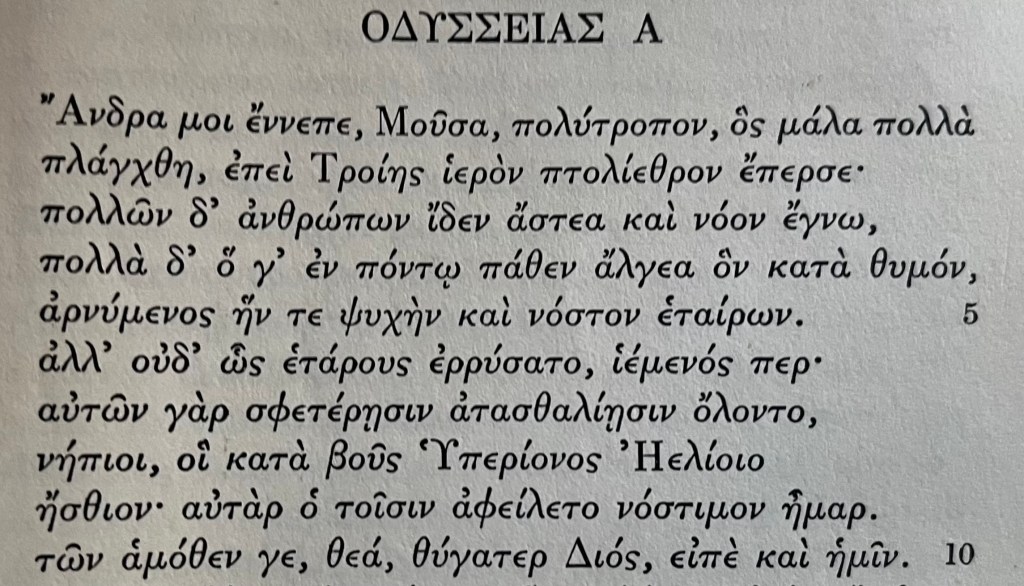
* For what it’s worth, I can still read but no longer easily translate the opening ten lines of The Odyssey pictured below.
** Attempts to mine The Iliad and The Odyssey for contemporary relevance are perhaps doomed to failure, if we are to believe Erich Auerbach’s essay ‘Odysseus’ Scar’ in his postwar classic of literary criticism, ’Mimesis’: ‘The Homeric poems conceal nothing, they contain no teaching and no secret second meaning. (…) Later allegorising trends have tried their arts of interpretation upon him, but to no avail. He resists any such treatment; the interpretations are forced and foreign, they do not crystallise into a unified doctrine.’
*** Since writing this piece about Nolan’s movie, I’ve not only read Emily Wilson’s translation of The Odyssey but managed to see Uberto Pasolini’s 2024 film The Return, co-written with Edward Bond and John Cole, and starring Ralph Fiennes and Juliette Binoche as Odysseus and Penelope, which dispenses altogether with scenes of Troy and Odysseus’ travels to focus on events in Ithaca. Austere in comparison to Nolan’s epic, and not having to bother itself (or us) about fantastic mythological creatures, it is a pretty decent, well-acted psychological drama about a family devastated by extended absence and consequent distrust. It mercifully doesn’t try to ‘modernise’ in terms of dialogue or values; but it does build to a very effective bloodbath climax that feels far more credible than the superhero antics of Nolan’s extravaganza. But is it Homer? Closer, certainly… but still not quite.
Christopher Nolan’s The Odyssey is currently on release and screening just about everywhere. The Return is available online.


One thought on “But is it Homer? Some thoughts on ‘The Odyssey’”