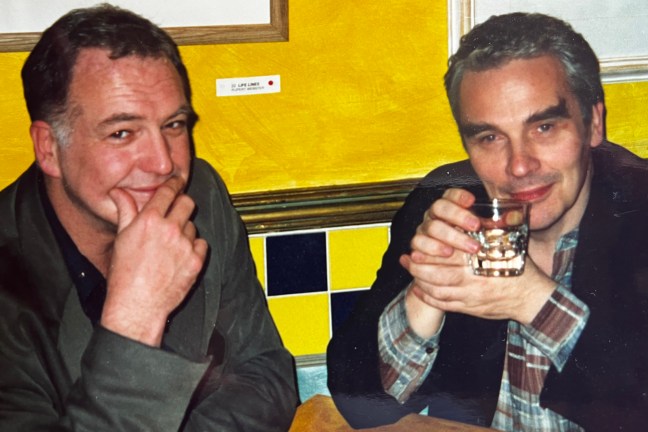
It is incredibly hard to write these words so soon after my remembrances of Tony Rayns and Brian Case, especially since I learned of the death of the film programmer, festival director and producer Simon Field just a few hours on the same day after hearing of Brian’s. But of the three – whose paths had all crossed during my years at Time Out – it’s fair to say that I was probably closest to Simon, and had remained so, having been in touch with him until the premature end. He died yesterday, aged 80; he will undoubtedly be deeply missed by a great many people around the world.
I was first introduced to Simon in 1988 by my friend Archie Tait; Simon, who for a decade and a half had been one of the editors of the radical film journal Afterimage, was going to take over from Archie as director of the ICA’s cinemas and film distribution. Back then, the support of Time Out for the ICA – then somewhat buzzier and with a rather higher profile than now – was deemed fairly important, hence the introduction. Happily, I got on very well with Simon, who proceeded to build very impressively on the success of his predecessors. So well, in fact, that he turned the venue (not without a little advice from Tony Rayns – who he’d known, through their shared interest in experimental cinema, for many years – and a lot of encouragement from yours truly) into probably the most progressive and most important cinema in London. Consequently, few were surprised when he was selected in 1996 to take over as director of the Rotterdam Film Festival, which would also be transformed during his time there. Simon held that post until 2004, when he moved into film production at Illuminations Films with his old friend Keith Griffiths (arguably the most audacious and truly independent UK producer for many years); their first films, for Peter Sellars’ international New Crowned Hope project, included mostly marvellous features by Mahamet-Saleh Haroun, Tsai Ming-liang, Garin Nugroho, Bahman Ghobadi and Apichatpong Weerasethakul. The last – Syndromes and a Century – proved to be a turning-point for Simon; Illuminations were also involved in the making of Apichatpong’s later works, including the Cannes Palme d’or-winner Uncle Boonmee Who Can Recall His Past Lives and the Thai writer-director’s first English-language feature Memoria. Despite illness for more than half a year, Simon had continued working remotely with Apichatpong on his forthcoming Jenjira’s Magnificent Dream up until his death.
Those are the bare facts of Simon’s illustrious career but they convey little of the man himself, other than his abiding interest in, devotion to and seemingly unquenchable thirst for non-mainstream cinema. His comprehensive knowledge, his taste and his ability to spot new talent were what earned him widespread respect around the world. But then there was also his enormous popularity, the genuine affection held for him by so many. Some of that could be put down to his suave good looks (this despite his famously bushy eyebrows), but mostly, I think, it came down to sheer charm. He seldom seemed to be out of sorts (though he took great pleasure in telling me he was almost as dyspeptic as I – as if!) and really did have what might be called a ‘sunny disposition’; even during his recent illness, he often seemed remarkably cheery, insisting he was ‘in good spirits’. He clearly loved the company of others (part of what made him such a fine festival director), and his rare elegance lay not only in the way he dressed (which I suspect may have had not a little to do with his life-partner Annie), but in the way he behaved and expressed himself. He was kindly, helpful, gracious, good-humoured, and respectful of others.* Small wonder that I have hardly ever, in almost 40 years of friendship, heard a single word spoken against him.
Small wonder, too, that I did get on well with him; besides our common passion for film, we also shared an interest in music (especially jazz and classical, attending a fair few concerts together over the years), art, books and birds. For many years we stayed at the same small hovel of a hotel – the fabled Chanteclair, now a comfy boutique joint since being renovated a decade or so ago – during the Cannes Film Festival (indeed, for our first year there, because we booked late, we were even reduced to sharing a room), and though we were on different screening schedules, we would very often end the day imbibing a rosé or two (or more) together – along with many other friends – at the Petit Carlton or the Petit Majestic. I would see less of him at the Berlinale, though I’d always catch up with him at his birthday party. But perhaps my fondest memory of spending time with him abroad was when he, Keith Griffiths and I took a long-weekend break in Czechoslovakia, which included a trip to visit Jan and Eva Svankmajer in their surreal manor-house deep in the countryside; it was, quite simply, an idyllic day. (Keith produced Jan’s features, Simon distributed and screened them, and I tended to write very favourable reviews of them.)
I also recall the countless enjoyable lunches and dinners over the years: sometimes just the two of us, sometimes with partners or friends, occasionally with filmmakers, including several with Takeshi Kitano and his entourage. But perhaps the most memorable of these was with Wong Kar-wai, at Gopal’s in Soho. I remember it not only because it was great fun (and lovely food), but also because I was suffering from bad lower-back pain. When we came out into Bateman Street after the meal, Kar-wai suddenly grabbed me from behind by the shoulders, knuckled his knee into my lower back and pulled my shoulders back sharply. Had he not quickly explained that this was treatment for my back pain, I am not sure what Simon would have done; perhaps more than anyone I knew, he was not pugilistic by nature. Fortunately, his characteristically relaxed, laughing presence seemed to reassure passers-by (and me!) that I was not being mugged. The evening ended very well, as it had begun.
I wrote some days ago that when I remember Tony Rayns, I still see his smile. In the case of Simon, I think I shall always remember him laughing. Thanks for all the good times, old friend. RIP.
The photograph at top dates, I think, from the mid-1990s.
*After reading my remembrance, Archie Tait wrote to me and mentioned Simon’s ‘equanimity’. I wish I had used that word, as it evokes Simon perfectly.


I am so sorry Geoff. Like so many others I loved Simon. He was part of the most magical years of my career in film and I know that so many of my contemporary were inspired by and/or worked directly with him. Lovely lovely lovely man
LikeLiked by 1 person
We are on the lost of a big friend and the lost of a big criteria in this unsalted times.
LikeLiked by 1 person
In the ferment and foment that was the ICA in the day, Simon sailed calmly through, charming, unassuming, but steadfastly sure of his purpose and judgement. His intellectual clarity and lack of overbearing ego were as inspirational as his eye for new films and new talent. How eagerly we waited to see his latest additions to the programme! And how evident it was that we would wish the world to see and appreciate them too.
RIP, great man of the silver screen.
LikeLiked by 1 person
What a wonderful obituary for an amazing, brilliantly funny and inspiring man. Thanks, Geoff, for those well-put words! Simon will forever be with us!
LikeLike