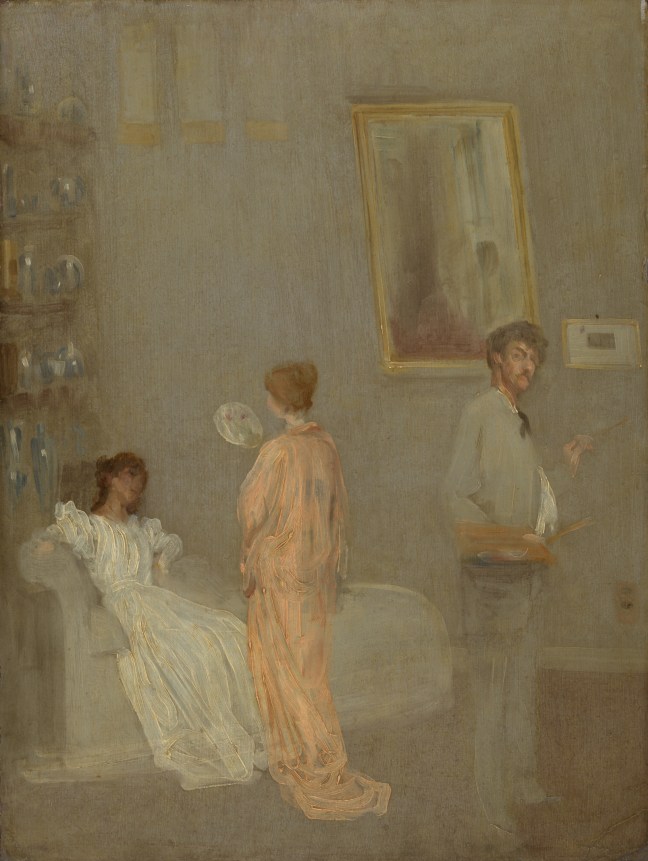
There are two exhibitions which recently opened in London that have a connection with Diego Velázquez – for me, as for so many, one of the very greatest painters in the history of art. The first – devoted to Francisco de Zurbarán (1598-1664), at the National Gallery – is a clear link, since he and Velázquez were contemporaries, friends and both major figures of the Spanish Baroque. For the second, Tate Britain’s extensive survey of the work of James McNeill Whistler (1834-1903), the connection is less immediately obvious, though the painting above – The Artist in His Studio (1865-66, courtesy Art Institute of Chicago) – may bring to mind Velázquez’s masterpiece Las Meninas. There are other echoes of the Spaniard in the American’s work, but more of that later.
The Zurbarán show – the first in the UK – is something of a revelation. Where his friend, famously court painter in Madrid to Philip IV, tended towards secular subjects, much of Zurbarán’s work is religious in content and/or allusion. Despite his immediately conspicuous expertise in technique and composition, I confess I find a few of the paintings either of academic interest – Hercules and the Hydra, for instance – or faintly surreal, even absurd: the Virgin floating in the sky, her feet supported by what appears to be a metaphorical plinth or tray comprised of the disembodied heads of cherubic infants. More often, however, one is impressed by the pictures’ adventurousness – perhaps most memorably a gigantic facial portrait simply entitled Colossal Head (two metres wide, two-and-a-half tall!) – and their highly effective use of chiaroscuro: Christ on the Cross, Saint Serapion and Saint Francis in Meditation are all fine examples.
The picture of Saint Francis is also notable for the extraordinary, near-tactile rendition of sackcloth. Zurbarán was the son of a haberdasher, and his immensely detailed accounts of clothes and textiles are remarkable. Saint Elizabeth of Thuringia (c 1640, Museo de Bellas Artes, Bilbao) is a case in point, and one of several pictures in which he included a held palm or plume which allows us to discern the material beneath.
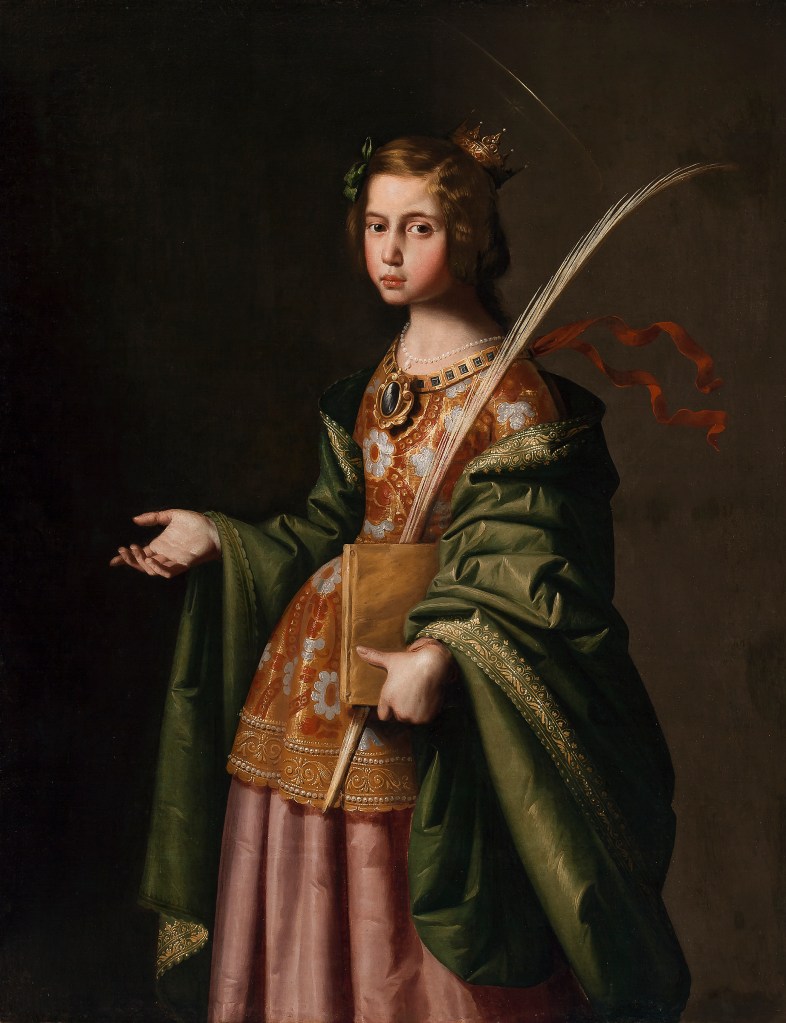
Such meticulous realism makes Zurbarán’s still lifes breathtakingly vivid: fruit, flowers, vessels of various kinds, water and, of course, reflections and shadows are executed with wondrous skill. (The exhibition also includes several exemplary still lifes by Zurbarán’s son Juan, who died aged only 29, a victim of plague.)
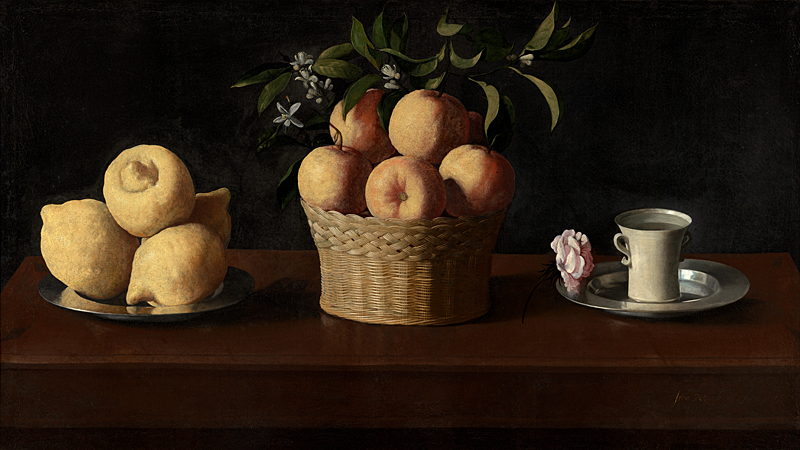
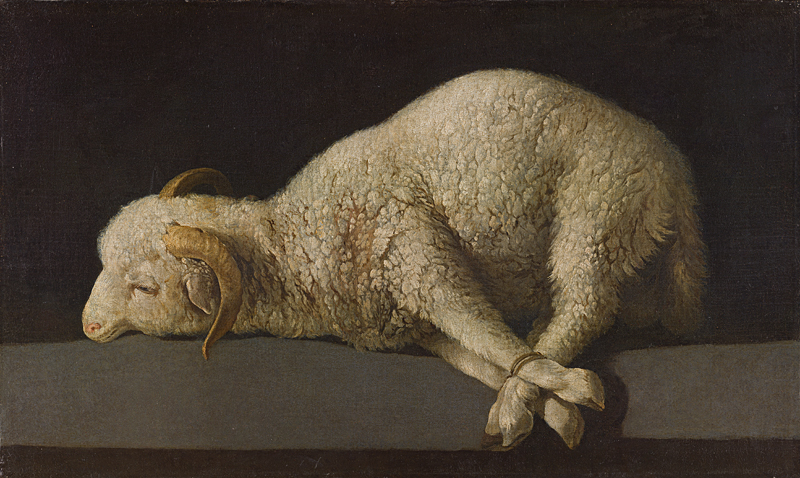
The astonishing skill evident in Zurbarán’s Still Life with Lemons, Oranges and a Rose (1633, The Norton Simon Foundation, Pasadena, California) can be found too in the superb depiction of the wool of a lamb awaiting – unconsciously but no less terribly – sacrificial death in the clearly symbolic Agnus Dei (1635–40, Museo Nacional del Prado, Madrid), an image which underlines the emotional heft of much of Zurbarán’s work on show.
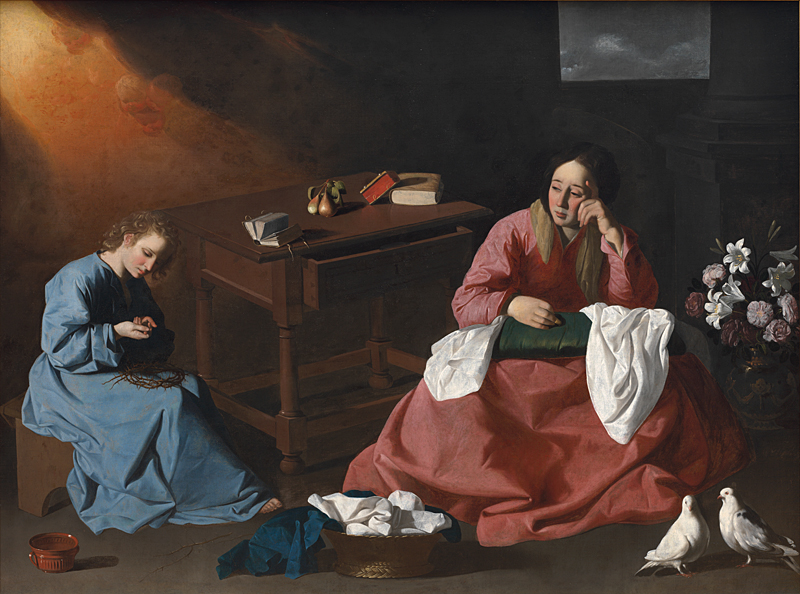
There are two pleasingly ‘homely’ takes on religious themes: The Young Virgin, in which Mary’s heavenwards gaze might hint at a disinterest in traditional domestic science for young women, and Christ and the Virgin in the House at Nazareth (c 1640, The Cleveland Museum of Art, Ohio), in which Mary notices her young son’s blood drawn by a crown of thorns he is (somewhat coincidentally) weaving. Some of Zurbarán’s religious art remains, to this atheist at least, wholly otherworldly; but there are also pictures where his strong sense of drama and his keen interest in humanity and suffering make his intentions, notwithstanding any metaphor and symbolism, crystal clear.
Though certainly no less thrilling, the Whistler show is, of course, quite different. Not that one can doubt his technical expertise; the sketches in his early notebooks – displayed publicly for the first time in an exhibition which, with 150 works, is the largest European retrospective in three decades – reveal a remarkable talent even in his teens. He did, however, take his time, it seems, to ‘find himself’ as an artist: just as his life was rather nomadic, so at one time or another he appears to have been influenced by – or testing himself as the equal of – the likes of Rembrandt, Courbet, Degas and others, not to mention his fascination with East Asian art and design (Chinese ceramics, Japanese painting, etc).That said, terrific paintings and prints abound: the raw realism in the portrait of La Mère Gérard; the vibrant etchings and paintings of modern life and labour down by the Thames, including Wapping (1860-4, National Gallery of Art, Washington); and seascapes and coastal pictures painted in northern France, with Green and Grey, Channel (The Sea), painted in 1865, already signalling his growing interest in subtle juxtapositions of colour and a growing tendency towards abstraction.
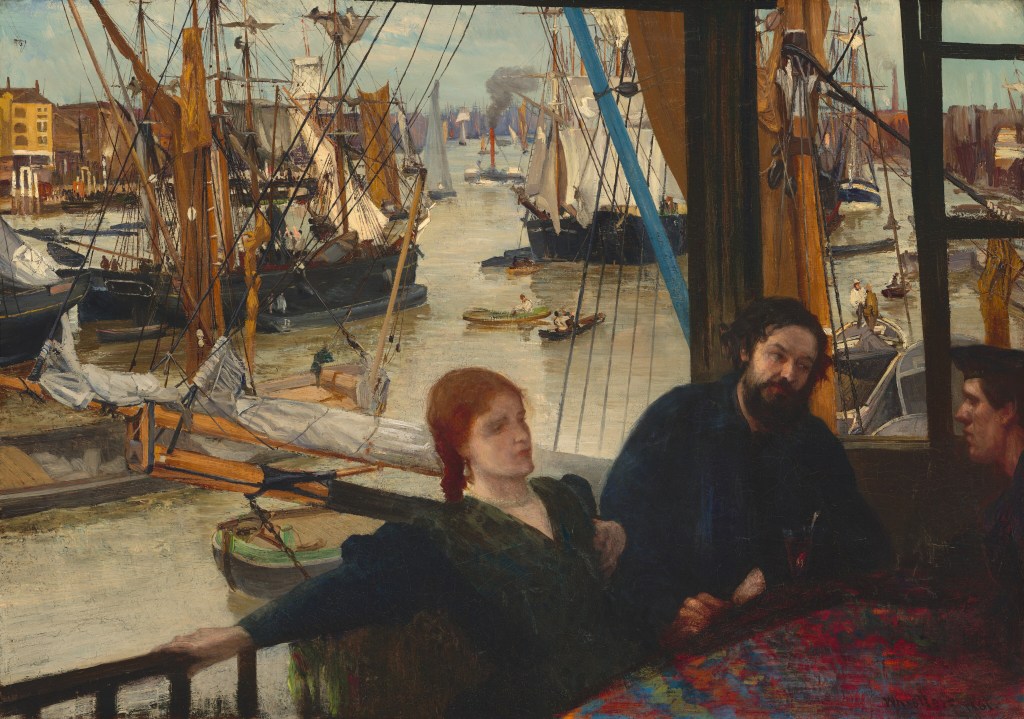
Wapping (1860-4)
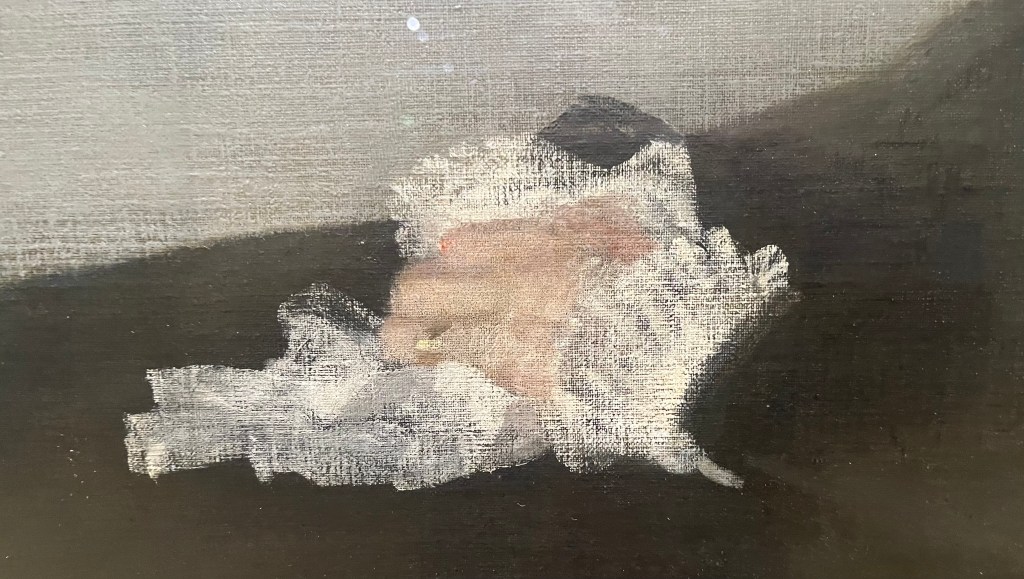
The mature Whistler style, famously, is at its most iconic in 1871’s Arrangement in Grey and Black No.1, otherwise known as Portrait of the Painter’s Mother, which is normally at the Musée d’Orsay in Paris. Purely as a portrait, it’s arguably not that great, in that it reveals little about its maternal subject; as a painting, however, it is deeply intriguing and stupendously beautiful in terms of its composition, play with muted colours, and evocation of surfaces, often deploying only the thinnest layer of paint. Here is a detail featuring hands and lace cuffs.
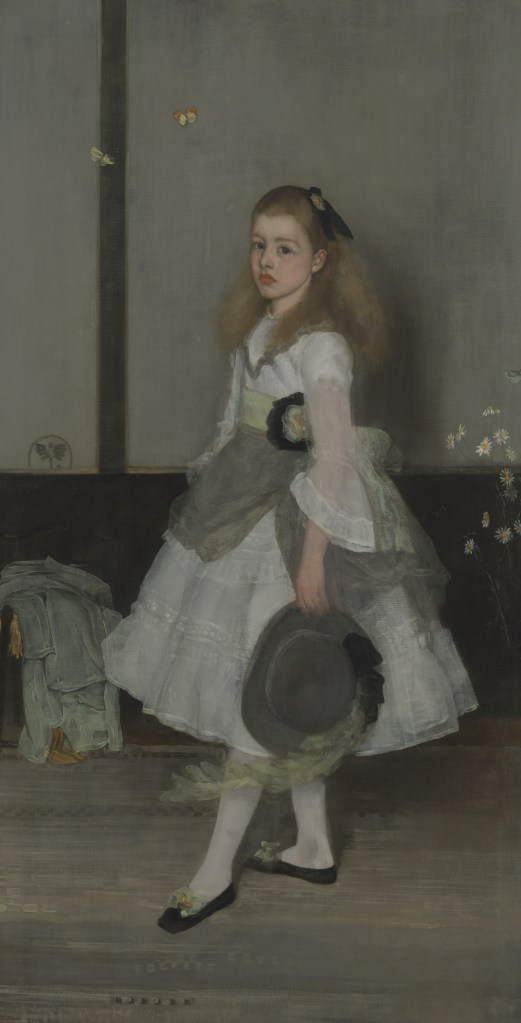
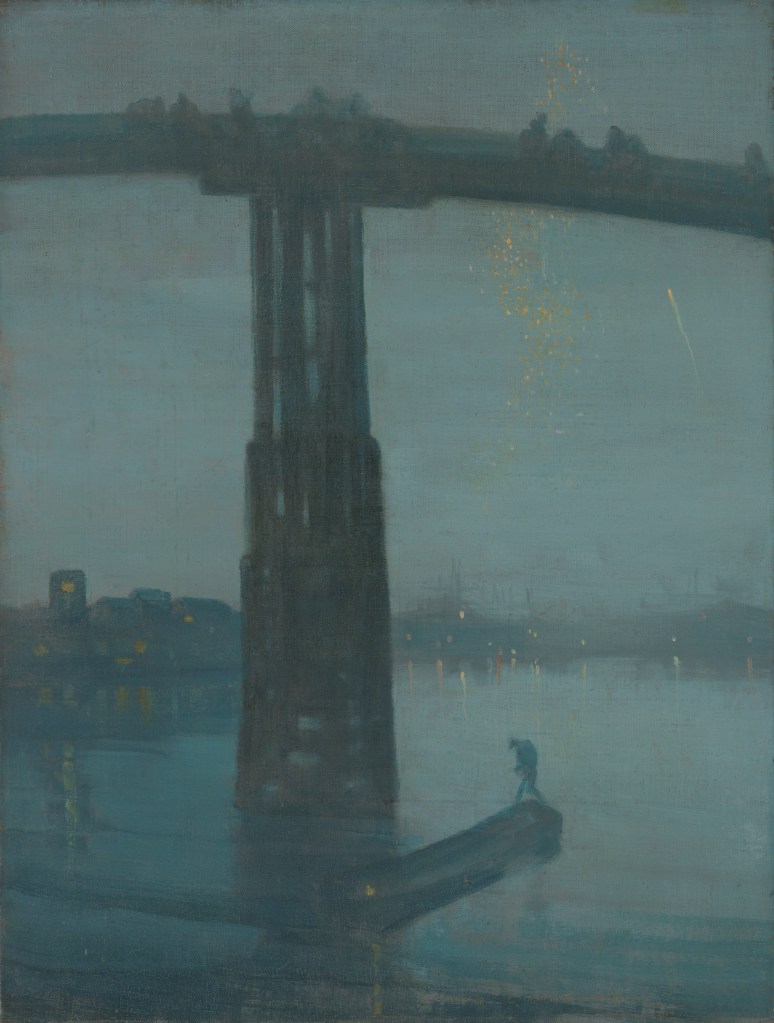
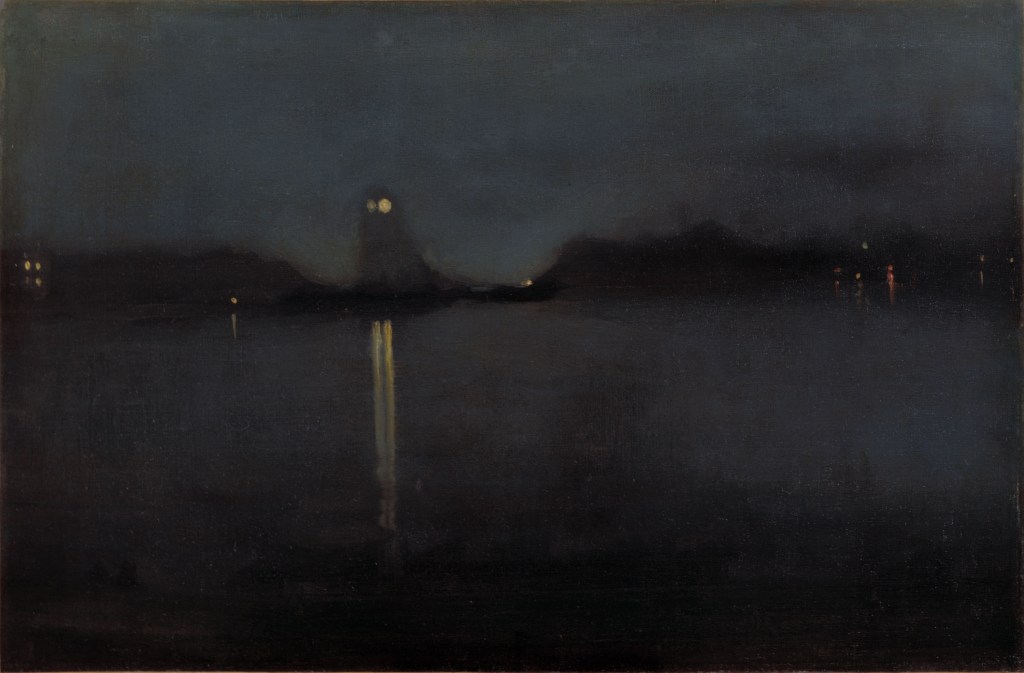
And so to the glory of the Whistler exhibition: a room full of his extraordinary ‘nocturnes’, of which there are 16 on display. As with the aforementioned portraits, these magnificent pictures painted in London, Southampton, Venice and Valparaiso – be they profoundly dark or merely crepuscular – are supremely suggestive examples of how to convey a lot with a little; and their beauty, especially when assembled together as in the Tate, is quite awesome (a word I almost never use, by the way). I would happily have chosen to illustrate this piece with any of the pictures, but below are the two made available by the Tate: Nocturne: Blue and Gold – Old Battersea Bridge (1872-5, Tate) and Nocturne (c1870-7, The White House © 2026 White House Historical Association). But best to see them all, of course, and in situ.
Whistler’s career ended in relative penury after he was bankrupted by a libel case against the critic John Ruskin, who foolishly dismissed one of the nocturnes as ‘flinging a pot of paint in the public’s face’. Thereafter he mostly produced smaller works, but as the etchings, lithographs, pastels and watercolours created in Venice, the Netherlands and elsewhere amply demonstrate, his very distinctive genius remained undimmed: The Palace: White and Pink; Sunset: Red and Gold –Salute; Off the Dutch Coast; and Snow are just four of the many small but utterly beguiling gems he produced in the 1880s. There is, too, Gold and Brown: Self-Portrait, from 1896-8, half a decade before his death. More revealing, perhaps, than that celebrated picture of his mother, but in the end, one can’t help feeling that it’s still, really, all about visual harmony – and paint.
Zurbarán continues at the National Gallery until 23 August; James McNeill Whistler is at Tate Britain until 27 September.
 notes and observations by Geoff Andrew