
There was, quite simply, no way I would willingly miss catching Festen, the new opera – based on Thomas Vinterberg’s 1998 Dogma film of the same name – by Mark-Anthony Turnage. Besides the movie connection, it offers an extraordinary cast, a dependably excellent conductor (Ed Gardner) and an acclaimed director (Richard Jones). And even though I never saw Turnage’s Greek or Anna Nicole, I was very impressed by his version of Séan O’Casey’s The Silver Tassie when I saw it in a concert performance at the Barbican in 2018. Why, then, would I not give his fourth opera a try? After all, I had pretty good memories of the film, which I reviewed favourably when it premiered in Cannes. Still, times have changed; how would Turnage and his librettist Lee Hall (of Billy Elliot fame) treat the film’s distinctive and tricky mix of heartfelt, troubling serious drama and extremely dark anti-bourgeois satirical comedy? Could they get that balance right? Or might they even pull some punches?
I bought my tickets anyway, but within minutes of the opera beginning, I saw there was no cause for concern. Indeed, it not only does justice to the film’s strengths – deft, economic plotting, vivid characterisations despite a large cast, and a willingness to deal with difficult, potentially controversial material – but in making a few judicious changes, its creators have actually managed to improve upon the original. For the most part, the setting and story, probably familiar to many, remain unchanged. In 1989 in the Danish countryside, a family, their friends and associates gather at a hotel to celebrate the 60th anniversary of Helge Klingefeldt (Gerald Finley), a wealthy businessman who bought the mansion as a family home years earlier. At the start of dinner, the eldest son Christian (Allan Clayton), invited according to tradition to make a speech, claims that he and his twin sister Linda – who later committed suicide there – were raped in childhood by their father. The guests respond with a deafening silence, though Christian’s mother Else (Rosie Aldridge) and younger siblings Helena (Natalya Romaniw) and Michael (Stéphane Degout) deny the veracity of his charge. Asked to apologise to Helge, Christian persists by offering further details, and things become ever more volatile…
Perhaps the most important change Turnage and Hall have made is to give the dead Linda (Marta Fontanals-Simmons) a voice – a wise, profoundly affecting decision, as it turns out. (That sister wasn’t properly seen in the film.*) Moreover, their treatment of Helge is arguably more in keeping with his character than was Vinterberg’s – not to say more in keeping with the rest of the complacent, complicit assembly. (These, after all, are people quite ready to accept, even repeat racist abuse when they hear it.) Remarkably, the opera manages to be both very funny at times (who’d have thought choruses consisting entirely of the word ‘hello’ or of comments about soup could be so telling and entertaining?) and deeply moving: Christian, Helena and Linda all have solos which are hauntingly beautiful yet never sentimental. Turnage’s music is imaginative, subtle and highly expressive throughout, from the jittery palpitations of the opening bars as Christian arrives at the hotel, through the aching, almost pastoral, Copland-like lyricism increasingly tainted by discord as he speaks of his and Linda’s ravaged childhood happiness, to the blaring, brassy jazz that accompanies a conga as the guests determine to ignore the gathering familial storm. Festen takes us on a roller-coaster ride, both dramatically and emotionally, and Hall’s smart libretto and Turnage’s sensitivity and sense of detail somehow ensure that it all coheres without jarring.
The staging is spot-on, too. To replicate Vinterberg’s cross-cutting in the earlier scenes, the opera very effectively has three different hotel rooms side-by-side on stage, deploying lighting to take us from one narrative strand to another while registering certain contrasts and echoes; the expert marshalling of a large cast in the dinner scenes is likewise lucid and deceptive in its apparent simplicity. And then there are the performances. Musically, these are as wonderful as one would expect from a cast which, besides the aforementioned, also includes Susan Bickley, John Tomlinson, Kitty Whateley, Ailish Tynan and too many others to mention. But there is also a lot of very fine acting. Given a CV that includes Hamlet, Peter Grimes and the wanderer in Winterreise, it’s hardly surprising that Clayton brings depth, complexity and vulnerability to Christian. But Dégout as the aggressively demanding Michael and Romaniw (whom I first saw alongside Clayton in a Proms performance of Britten’s War Requiem) as the haunted Helena are memorably fine, while Finley and Aldridge are excellent as their parents; the last contributes one of the opera’s most electrifying moments. Nor should we forget the contributions of the orchestra, bringing out the brilliance of Turnage’s colours, textures and dynamics under Gardner’s characteristically meticulous direction.
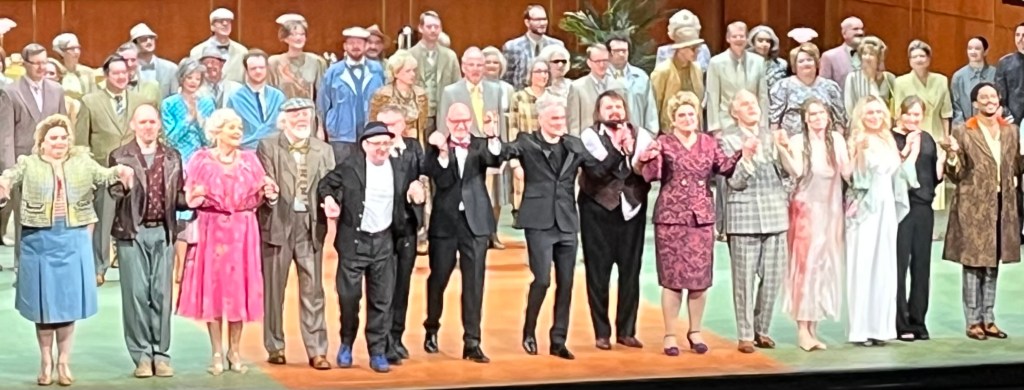
Festen deals with child abuse, incest, suicide, trauma, racism, violence, adultery, dementia, deceit and denial: the refusal or inability to face up to unpleasant realities. What could be more pertinent? But that certainly doesn’t make it a downer. More importantly, it’s a great new opera. As I write, there are seats still available, but judging by the rapturous reception at the first night, they may not be for very long.
Festen continues at Royal Ballet and Opera (ie the Royal Opera House, Covent Garden) until 27 February.
*I originally and erroneously wrote that the dead sister ‘wasn’t even seen’ in the film, but that was a slip of the memory; a friend pointed out that Christian does see her briefly in a hallucination.

 notes and observations by Geoff Andrew