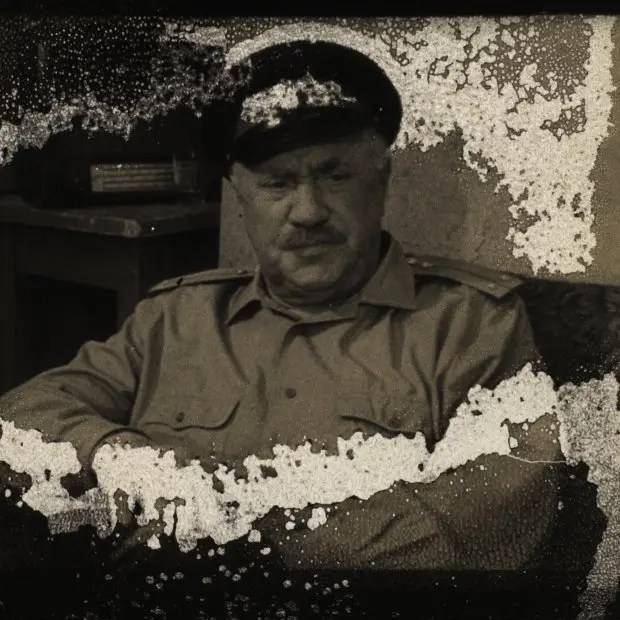
As anyone who has seen Decasia (2002) or Dawson City: Frozen Time (2016), by the New York-based artist and filmmaker Bill Morrison, may be aware, there can be something strangely beautiful about film –film, the physical entity – decomposed by the passing of time. Even before I saw the former title, I’d already been intrigued by the haunting qualities of the ancient, damaged home-movies used in Train of Shadows, a 1997 film by José Luis Guerin, the very fine Catalan filmmaker best known for the marvellous In the City of Sylvia, but Morrison’s films went still further in revelling in how damaged film can evoke spirits, ghosts, monsters. The shapes on screen are essentially abstract, of course, but at the same, either in themselves or in the way they interact with what remains of the original image, they can imply the presence or influence of something mysterious, inhuman, otherworldly: inextricably linked with death and decay but hinting, too, at something that has somehow endured, against all odds.
Please forgive the purple prose, but sometimes the effects of erosion on old film – film made in, and reflective of, a world very different from our own – can be quite startlingly vivid and magically entrancing. One doesn’t need to be as devoted to degraded archive materials as Morrison clearly is, in order to appreciate the special appeal of such unintended imagery. If you’re unfamiliar with his work but would like to investigate what I’m blathering on about, you could do far worse than check out the new BluRay release of his 2021 film The Village Detective: A Song Cycle. It’s not just for cinephiles and fans of the historically arcane; Morrison has regularly worked with interesting and important contemporary composers, and this time his musical collaborator is David Lang, co-founder of the Bang on a Can collective (together with Julia Wolfe and Michael Gordon, the latter the composer of the extraordinary score for Decasia). That said, it’s not really a song cycle as such…
The film came about after Morrison was contacted by another composer friend, the late Jóhann Jóhannsson, who told him of some film cans recently dredged up from the depths of the mid-Atlantic by an Icelandic fishing-boat. It turned out that the reels were from a Soviet mid-60s characterful crime comedy-drama (think Columbo out in the steppes) entitled The Village Detective – not a silent-era rarity after all; but Morrison felt intrigued enough to investigate further, whereby he decided to use the damaged footage as the springboard for an exploration of the movie’s star, Mikhail Zharov, an enormously popular actor in Russia at the time, who’d been working in the movies for decades. (Aficionados of Soviet cinema will be interested to learn that the highly versatile Zharov worked – admittedly, initially, in minor roles – with Protazanov, Pudovkin, Ekk, Barnet, Kozintsev and Trauberg, among others, not to mention with Eisenstein in the epochal Ivan the Terrible films.) Interspersing fragments of the narrative of The Village Detective with a chronological survey of Zharov’s career allows also, of course, for reflections on socio-political changes in Russia during that time; suffice to say that Lenin and Stalin make appearances along the way. It’s certainly a fascinating story.
And the music? Well, Zharov’s acting career was improved no end when he was seen and heard singing in the first Soviet sound film (Nikolai Ekk’s Road to Life). Indeed, he sang in many movies, often accompanied by that near-universal folk-favourite, the accordion – the irresistibly versatile instrument deployed in David Lang’s lovely and very resonant score.
If the engagingly meandering narrative of The Village Detective: A Song Cycle means that it’s a little less intense or compelling than Decasia or Dawson City…, no matter: it’s accompanied on the new disc by some very welcome additional material. True, Sunken Films (2020) – a precursor to the main event, about other reels rescued from watery graves – and Let Me Come In (2021), illustrating an okay minimalist song by David Lang performed by Angel Blue to accompany footage from a 1928 German movie entitled Pawns of Passion, are both brief and fairly minor. But the 40-minute Beyond Zero: 1914-1918 (2014) and the half-hour The Unchanging Sea (2018) are more than mere ‘extras’: the first consists of footage shot (evidently by both sides of the conflict) during World War One, set to a reverbative score composed by Serbian-American composer Aleksandra Vrebalov and performed by the Kronos Quartet; while the second, with likewise excellent music by Michael Gordon, compiles a strange, elliptical and enigmatic narrative from archive scenes set on coastal rocks, on ships or boats, or actually in the sea. The latter is atmospheric, witty, unsettling, dreamlike, even mythic – you can watch an excerpt here; the former proceeds from pomp, pageantry and parades, through preparation of artillery and trenches, to outright carnage, chaos and apocalyptic devastation, the nightmarish horror of it all complemented and evoked by the explosive imagery of the decomposed film; again, here is a brief excerpt. The film’s final sequences, taking in woefully fragile aircraft, slowly lumbering tanks and a lone, horribly vulnerable parachutist, speak volumes about a world in freefall.
Bill Morrison’s The Village Detective: A Song Cycle is released by Second Run on 26 February 2024. Here, to give you an idea of The Village Detective: Song Cycle is a trailer; here, in case you missed Decasia, is a trailer for that film.
 notes and observations by Geoff Andrew