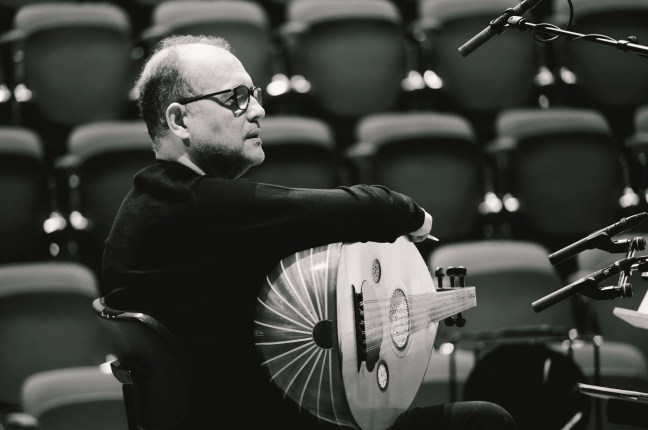
I can’t recall precisely when I first heard the music of the Tunisian oud maestro Anouar Brahem; it was probably when I bought Madar, an album of duets with Jan Garbarek, released in early 1994, which was some months before I saw Moufida Tlatli’s film The Silences of the Palace, for which he wrote and performed the music. (He also provided the music for her 1999 follow-up The Season of Men – a couple of tunes composed for that movie would re-emerge in slightly different form on Brahem’s limpid and luscious 2002 trio album Le pas du chat noir.) But I became fully aware of what a remarkable musician he was only when I saw him perform live in London with John Surman and Dave Holland, around the time of the release of their 1998 album Thimar. Thereafter I was hooked, buying not only Brahem’s every subsequent album but also his earlier discs, all of them on ECM.
One of the many great things about Brahem – whose genre-defying music stems from classical oud traditions but also takes in jazz, chamber and orchestral music, and much more – is that however much he may change the instrumentation, the music always sounds like his and his alone. So while his recently released After the Last Sky is the first album to feature a cello – except, that is, for 2014’s Souvenance, a suite for oud, quartet and string orchestra, and a couple of tracks he contributed as guest on Charmediterranéen, an absolute gem featuring Paolo Damiani and the Orchestre National de Jazz – it comfortably inhabits the same musical territory as all its predecessors: a territory that is forever expanding as he effortlessly pushes aside (or simply ignores) generic boundaries. Brahem’s previous release – the glorious Blue Maqams – boasted three great names in jazz: bassist Dave Holland, pianist Django Bates and drummer Jack DeJohnette. After the Last Sky replaces DeJohnette with cellist Anja Lechner, a classical musician who’s already shown her musical openness and readiness to improvise on numerous albums with the likes of Argentinian bandoneon master Dino Saluzzi and French pianist François Couturier (himself a long-term member of Brahem’s extended musical family) – so she fits the bill perfectly.

Given that the new album features four stringed instruments being plucked, strummed, bowed and beaten, you might expect it to be a little lacking in colour. Not at all; Brahem is constantly shifting the instrumentation between various solos, duets, trios and the full quartet, just as you might be listening one moment to something seemingly North African or Middle Eastern in essence, and the next to something distinctly flavoured by jazz, tango, classical, folk or whatever. Similarly, the fact that the quartet recorded the music (composed by the summer of 2023) in May 2024, by which time the Gaza Strip had been subjected to genocidal carnage, certainly affected Brahem’s mood and feelings about the music; the titles of the various tunes, and that of the album – taken from a poem by Mahmoud Darwish which asks, ‘Where should the birds fly after the last sky?’ – are indicative of the composer’s concerns, fears and sympathies. (He has always been a political animal; indeed, I recall speaking with him years ago at the Locarno Film Festival, prior to a screening of Mots d’après la guerre, a documentary he had made about Israel’s attacks on Lebanon.) Yet the music itself, with lovely interplay between the superb musicians, is in no way didactic; indeed, while some of it is imbued with an elegiac melancholy, other parts are surprisingly upbeat, evocative of happier times, hope and resilience. And all of it is not only eloquent and elegant, but unassertively beautiful – perhaps an act of resistance in itself, as well as an expression of communal creativity that knows no borders. You can watch/listen to the title track here.

While we’re on the subject of music and politics (or the state of the world), I’d like briefly to draw your attention to three other recent albums. Also on ECM, we have a second album of terrific, largely improvised duets by Vijay Iyer and trumpeter Wadada Leo Smith, aptly titled Defiant Life; as Iyer writes in the liner notes, the recording session ‘was conditioned by our ongoing sorrow and outrage over the past year’s cruelties, but also by our faith in human possibility’. You can listen to their account of Smith’s Floating River Requiem (for Patrice Lumumba) here. Then there is a new album by Arve Henriksen, about whose music I have often enthused; again a direct response to recent developments, it’s titled War Index and is for obvious reasons rather less lyrical than most of Henriksen’s work, though it strives to end on a positive note. It’s available on Bandcamp, and you can listen to a sample here.
Finally, there is Jorden vi ärvde (which translates at The Earth We Inherited) by Vilhelm Bromander and the Unfolding Orchestra. I confess I’d never heard of the Swedish bassist-composer or the orchestra until a publicist emailed me a few weeks ago about the album… and I’m very glad they did. Not only is the album an attempt to reflect on and counter the current crisis, but it’s also a tribute of sorts to the consistently brilliant blend of music and politics compiled by Charlie Haden and Carla Bley in their magnificent decades-long collaborations on various Liberation Music Orchestra projects. As with Ohad Talmor’s Back to the Land, which very successfully revisited the musical universe of Ornette Coleman, Bromander’s album is no mere act of mimicry; indeed, it sometimes departs quite dramatically from Bley’s orchestration (not to mention her spare piano style) and there are moments when one is reminded of Ornette, Alice Coltrane or other composers who emerged in the mid-twentieth century. No matter; the album boasts marvellous harmonic and melodic invention, and real fire and subtlety in the band’s performances. You can listen to a brief teaser here or watch a (seemingly amateur) video of a club performance of the track For Dewey here. (That’s Dewey Redman, by the way.) I guess I’ll probably be following Bromander in the future…
Postscript: a plug for one more recent album, which seems to be autobiographical rather than political (though who knows?), and which perhaps – though I’m far from sure about this, given its genre-blind tendencies – leans a little more towards folk than jazz. But it’s definitely worth checking out. Titled Song over støv, which means Song over Dust, it’s led and composed by Hardanger fiddle-player Erlend Apneseth (who played in Frode Haltli‘s Avant Folk band); it’s performed by a large ensemble (including Haltli, bassist Mats Eilertsen, some of the Avant Folk group, not to mention four Hardanger fiddles!); and it’s compelling throughout. The title track, with a wonderfully wild, characteristically imaginative solo by the extraordinary Haltli, is especially fine.
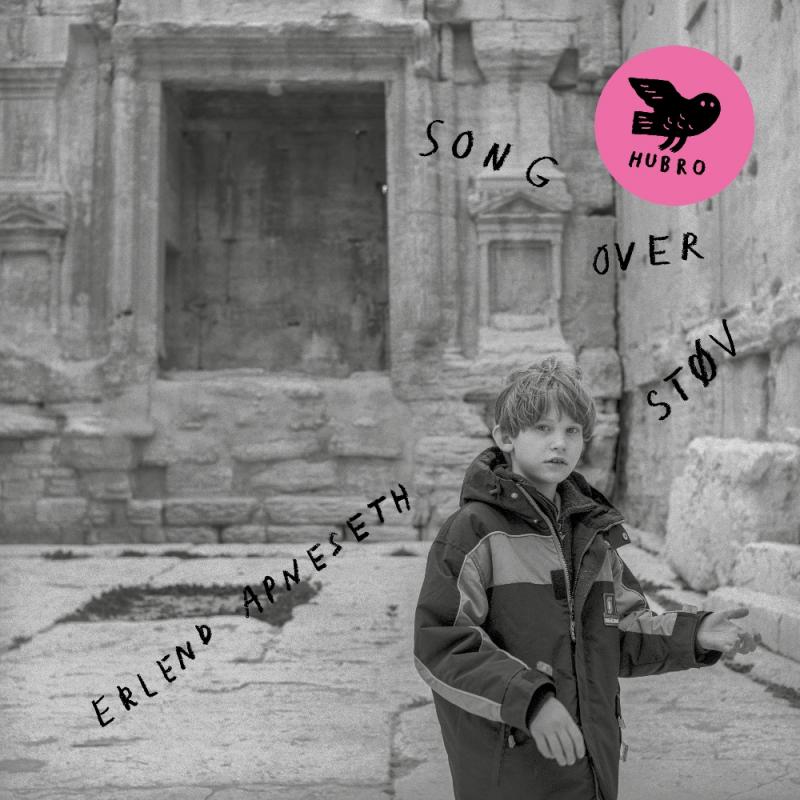
After the Last Sky and Defiant Life are released by ECM. War Index is available through Bandcamp or https://arvemusic.com. Jorden vi ärvde will be released by Thanatosis and available through Bandcamp in late April. Song over støv is released by Hubro. Photograph of Anouar Brahem by Sam Harfouche, courtesy ECM.
 notes and observations by Geoff Andrew
Just wanted to say how much I enjoy these posts, Geoff. That’s a fine selection of new albums, mostly especially perhaps the Anouar Brahem. “Not only eloquent and elegant, but unassertively beautiful.” Precisely. And yes, the Vilhelm Bromander is new to me too, so looking forward to checking that out. Many thanks! (If you like these albums, you will no doubt appreciate, if you haven’t heard already, Ambrose Akinmusire’s new release, Honey from a Winter Stone, which occupies some of the same musical/personal/political terrain.)
LikeLike
Many thanks for the kind words, and the tip. I haven’t yet heard Honey from a Winter Stone, but will endeavour to do so.
LikeLike