
I’ll confess that when I first read that Tate Britain was to mount an exhibition entitled Turner and Constable: Rivals and Originals, I wasn’t exactly filled with excitement. Don’t get me wrong: Turner has been one of my favourite artists ever since I first saw his work at the Tate in my mid-teens, and while Constable doesn’t hold nearly as important a place in my painting-related affections, I’ve always appreciated his remarkable technique and his brilliant studies of clouds. No, the reason for my initially tepid response to the idea was simply one born of a presumed familiarity; I felt I knew both men’s work reasonably well, and that the idea of exhibiting their works together was… well, a bit obvious.
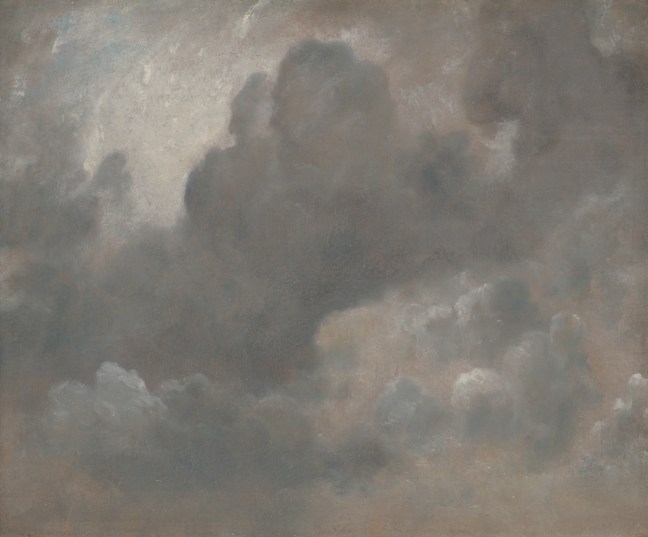
Happily, I very quickly changed my mind, deciding that it would be folly even to consider missing an exhibition devoted to two major artists both known primarily for landscapes but both very different in terms of style and preoccupations. Happily, because the exhibition is jam-packed with superb paintings, quite a few of them on public display in Britain for the first time in decades or, in some cases, far longer, so the problem of familiarity is fundamentally irrelevant. Moreover, this 250th anniversary show – Turner was born in 1775, Constable the following year – is curated in such a way that having the artists exhibited alongside each other enables one to explore not only the differences in their work, but the similarities. Yes, Turner’s pictures generally feel more epic, more mythic, more abstract, timeless and suffused with primal energy, while Constable’s feel more densely detailed, more domestic, more concerned, in a very evidently naturalistic way, with what was, at the time of their painting, the here and now. But that is only part of the story; there are pictures in the show where such seeming polarities are blurred, even disappear; both men, after all, were focused on how to deploy colour, light and composition to evoke what they saw as the essence of the natural world.

I’m not going to discuss here the various differences in the pair’s personalities, backgrounds, ambitions, frustrations, experiences or even their methods; those are all dealt with succinctly and illuminatingly by the exhibition, and anyway you can easily find out for yourself, online or through books, about the lives of the artists. Nor am I going to bother to argue for their greatness – that seems unnecessary, besides which there are many far more qualified than I to do so. I’m simply going to urge you to see the exhibition if you’ve a chance, because however familiar you may feel you are with the work of either painter, there will be surprises – and I don’t just mean Turner’s stunning sketchbooks, or Constable’s little sketching chair and paint box, or even the paintings notable for not having been seen here in ages. It’s not just about rarity.
There are small, early works by Constable like the 1800 drawing Helmingham Dell, the 1806 pencil-and-watercolour Saddleback and part of Skiddaw, the 1810 oil sketch View of Dedham from the Lane leading from East Bergholy Church to Flatford, or the 1816 oil sketch Path Towards Stratford St Mary – all these had a slightly dark, brooding intensity which I hadn’t expected. Then there is the unusual framing of Turner’s early South view of Salisbury Cathedral from the Cloisters (1802) – very different from Constable’s 1823 picture of that church – not to mention his miraculous watercolours: however many times one may see mirages like The Sun Rising over Water (1825-30) or The Rooftops of Venice… (1840), they never fail to astound with their audacity, their simplicity and their ravishing beauty.
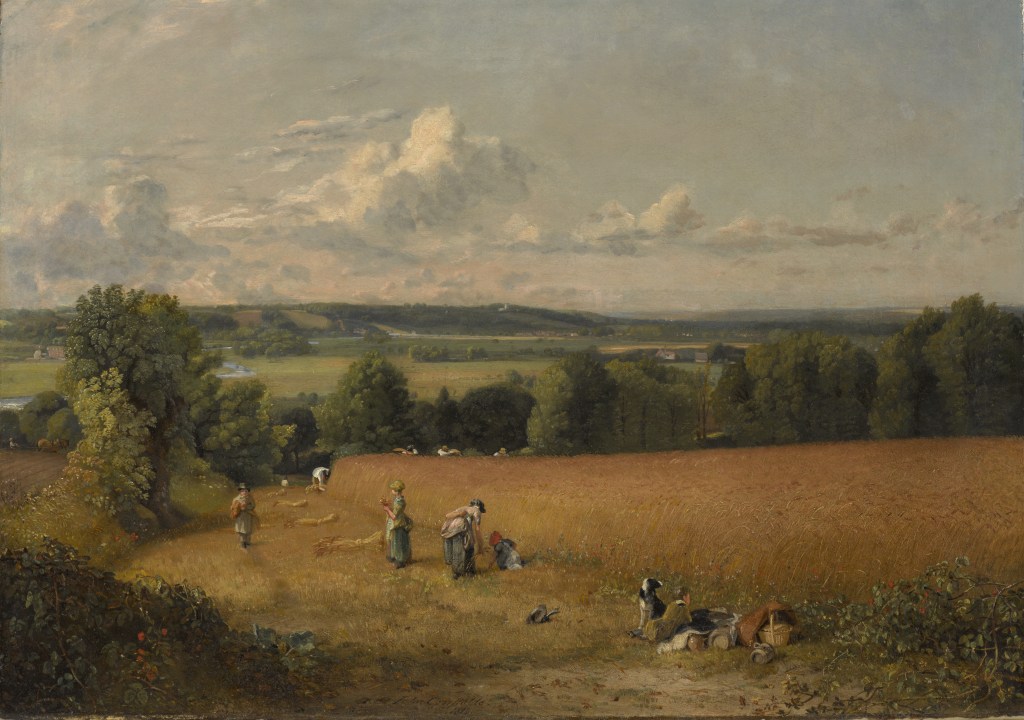
The aforementioned paintings were not among the images proffered by the Tate’s press office; no matter, as those I’ve included are equally impressive to see in the exhibition (rather than in a book, on a postcard or, of course, on a screen.) Three of my selection are not usually on display in London; to stand in front of them, in such a satisfying exhibition, felt to me something of a privilege. There are many such wonders among the 190+ images in this show; if you are able to get there, I suggest you don’t let it pass you by.
(By the way, if you haven’t yet made it to Radical Harmony: Helene Kröller-Müller’s Neo-Impressionists – continuing at the National Gallery until 8 February – I also recommend that exhibition. Apart from anything else – and there is much to enjoy – I never quite ‘got’ Seurat until I went to the show; his drawings and the three Channel of Gravelines paintings were real eye-openers.)
Turner and Constable: Rivals and Originals is at Tate Britain until 12 April 2026. The painting at top is JMW Turner’s Keelmen Heaving in Coals by Moonlight (1835), courtesy National Gallery of Art, Washington, Widener Collection.
 notes and observations by Geoff Andrew