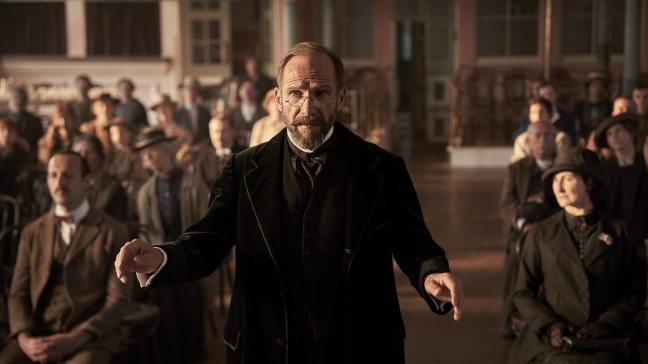
I’ve generally been more admiring of Alan Bennett’s books and his writing for television (particularly the superb Talking Heads monologues) than of the films either adapted from his plays or based, in the case of A Private Function, on an original screenplay. Still, I’ve counted myself a Bennett fan since first encountering him in the mid-60s in his TV series On the Margin, and the fact that I joined a local choir at the start of this year to sing Brahms and Beethoven – something of a transformative experience, as it turned out – meant there was no way I wasn’t going to check out The Choral, a new original screenplay by Bennett brought to the screen by director Nicholas Hytner. Given the writer’s age (he’s now 91) and the frequency of his collaborations with Hytner since 1991 (when they first worked together on The Madness of King George), I certainly wasn’t expecting any surprises, but a film about art, class, sexuality, faith and so forth set in Yorkshire sounded exactly the sort of subject they could do well, especially since the cast included Ralph Fiennes, Roger Allam, Mark Addy, Alun Armstrong and Simon Russell Beale.
Indeed, it proves to be a very pleasurable film about all those things… and more, because it is set in 1916: the reason new members are desperately needed for the choral society of a Yorkshire mill town is that many of the tenors and basses have gone off to fight in the trenches, some probably never to return. Which means that, for all the characteristically droll Bennett wit involved in relating the choir’s attempts first to mount a performance of a Bach Passion, and then – all Germans now being deemed the enemy, including their dead composers, however great* – to opt instead for an account of Elgar’s The Dream of Gerontius, there is a constant undertow of darkness: war casts its shadow over everything. That, in the end, rather than any of the romantic complications between the young men and women in the choir, or the various obstacles inevitably overcome in the run-up to the performance of Gerontius, is what gives the film its true substance.
While the plotting is often (but quite agreeably) a tad predictable, and the direction mostly no-nonsense rather than inspired, the performances – by the aforementioned familiar faces and a clutch of lesser-known younger actors – are uniformly fine; if a cameo depicting Elgar comes across as just a little too larger than life, that is perhaps intentional, given the impression the illustrious composer might have made on the members of an unremarkable Yorkshire choir. Bennett is alert both to how all his characters’ lives have been transformed by war, and to the restorative power of music: though the film goes slightly off the rails in its last quarter, first with a sappy musical montage depicting the outdoor rehearsals of the various sections of the choir, then still more so with the supposedly climactic but (to me, at least) rather absurd scenes of a semi-staged performance of Gerontius, the treatment of the choir’s auditions and practice sessions is for the most part sensible. (Although it never really touches on the hours of work required, it does at least suggest how a choir’s standard of performance can sometimes shift in a surprisingly short period of time from what seems hopelessly abysmal to something far more pleasingly and recognisably musical.)
There’s a lot of stuff in terms of narrative and characterisation I haven’t touched on – why, for example, Fiennes’ new choirmaster is initially seen as an unwelcome appointment – but I prefer to provide as few spoilers as possible. All you need know, really, is that it’s a putting-on-a-show story set during World War One, and that it’s funny and affecting, as well as insightful on various levels. And I for one recognised the exhilaration the singers and musicians felt at the completion of their performance of Elgar’s glorious music. On that level, it certainly struck a chord. That said, you surely don’t need to be a singer to enjoy The Choral; if you’re a fan of Bennett’s work, you’re unlikely to be disappointed.
* At one point early in the film, the choir’s committee are discussing whose music they should perform, given that ‘the Huns’ are now out of bounds. ‘How about Handel?’ suggests one character, only to be informed of his error. Had he been in our choir, he would very likely have known that before the composer was Anglicised and became a British subject, he was the German-born Händel, since one of the choir’s members, Helen Dymond, has written an illuminating book called Finding Handel. Though partly fictional in dealing with one short, somewhat mysterious period of his life, the book is firmly grounded in reality, a lively, well-written read and an imaginative, very entertaining way of finding out quite a lot about the man and his music without having to resort to a lengthy biography. The people you meet when you join a choir! The book is readily available online.
The Choral is in UK cinemas now.
 notes and observations by Geoff Andrew