London is always a great city for art, and while there are several current exhibitions I’ve yet to get to*, this summer has some superb painting on offer, in addition to the many masterpieces on permanent display. I’d meant to write before now (but for various reasons didn’t get around to it) recommending the Edward Burra show at Tate Britain. I was not really familiar with his work prior to this exhibition, which covers his career from the 1920s to the 70s, but I found it fascinating and truly distinctive. Working in watercolour, often on a surprisingly large scale, he developed a highly personal style, which moved from vivid, slyly satirical pictures of people – both the fashionably bourgeois and those marginalised in one way or another – in the cafés, nightclubs and watering holes of Paris, the South of France and Harlem, New York – through dark, bizarre, quasi-mythical evocations of the horrors of war (both the Spanish Civil War and World War Two as observed in the mobilising of Allied troops near his East Sussex home), to the glories of the British landscapes suffering the effects of postwar industrialisation. Some find Burra’s take on the world misanthropic – a bitterness arising, perhaps, from years of ill health (rheumatoid arthritis meant that he had to paint on a horizontal surface) – but I found the paintings here strikingly bold, imaginative and intriguing. There is a faintly sardonic, almost absurdist wit to pictures like The Two Sisters (1929) and Marriage à la Mode (1928-9); a rewarding turn towards surrealism and timeless abstraction in The Hostesses (1932), The Watcher (1937) and the war paintings; and a prescient sense of the destruction of the environment in late pictures like Picking a Quarrel (1968-9) and Cornish Clay Mines (1970). Misanthropic? Well, some of the early paintings did remind me of Otto Dix and George Grosz. But I also felt, in many of the works on display, a genuine curiosity about people; even compassion, perhaps. Whatever, his colours and compositions are surely proof of a master of his medium.

Technical excellence is also to be found in Jenny Saville: The Anatomy of Painting, at the National Portrait Gallery. Once a Young British Artist, now firmly established, in the NPG’s words, as ‘one of the world’s foremost contemporary painters’, Saville specialises in large pictures of nudes – mostly but not exclusively female – and faces; indeed, the 45 works in the chronologically ordered show are sensibly gathered into groups showing individuals (either full-length or faces), mothers and infants, and couples. Saville is a figurative artist who has, it seems, sought to transcend notions of naturalism or realism by introducing a level of abstraction or formalism; an admirer of Titian and Michelangelo, she also acknowledges the influence of de Kooning. So her expert evocation of the contours of human flesh – there is one beautiful charcoal study of a woman’s neck – is frequently accompanied, or overlaid, by lashings of paint, often in lurid reds, greens or blues. Again, this is bold stuff, with a strong, almost tactile sense of the weight, texture, malleability and fragility of human flesh. Some seem to take the colours and distortions quite literally, believing that Saville’s subjects are often victims of violence. My own response, however, was that the twisted mouths and blood reds were probably not to be read as evidence of bruising so much as experiments with shape and colour – experiments with paint itself, often applied with thick strokes. The tones and layers are as integral a part of Savile’s interest in different ways of articulating form as are the impossibly intertwined limbs of multiple bodies in her pictures of couples. It is as if she takes a visual motif – a face, a couple, a mother and child, a pietà – and repeatedly performs variations upon it.
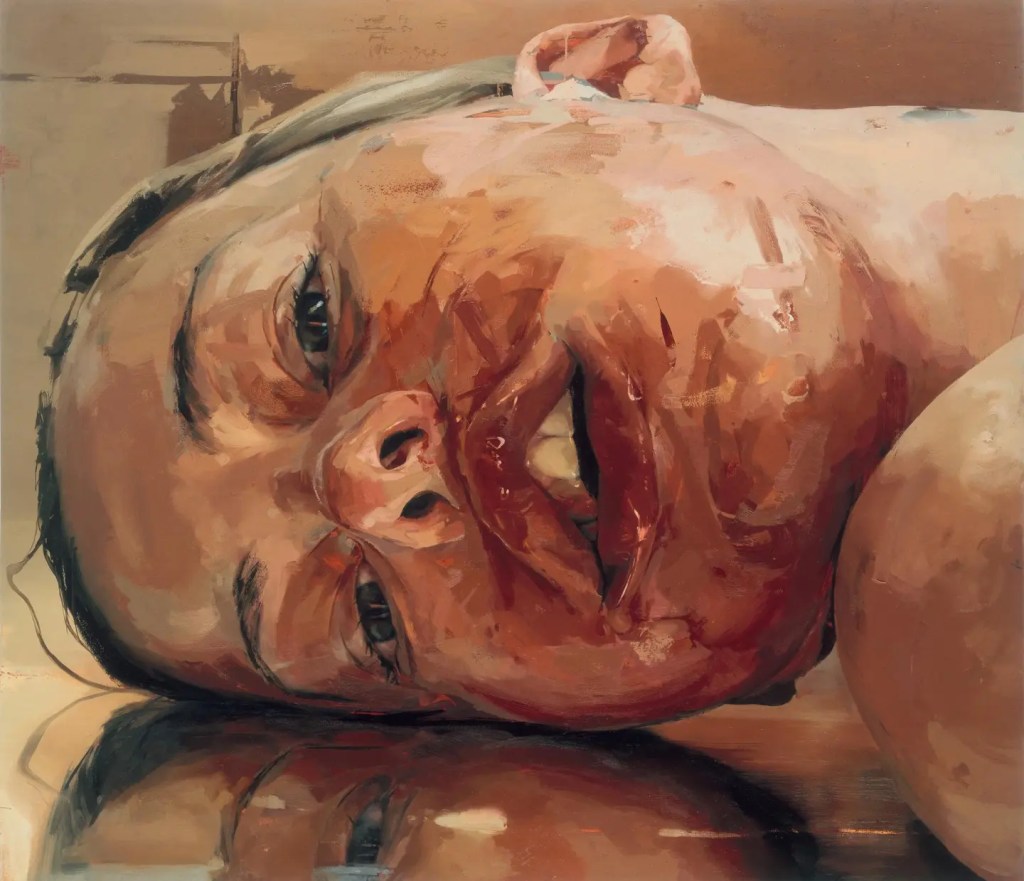
For all that individual pictures impress – and I generally preferred the drawings to the paintings – to see almost four dozen of them gathered together is a tad oppressive. The effect is repetitive and, in the emphasis on size, faintly oppressive. I also found myself wondering whether the dearth of personality was intentional. I can only presume so, since Saville’s technique is so impressive; perhaps, in her obsessive focus on flesh, she has simply decided to ignore character, mood, the mind,soul or whatever. Hence all the blank, unilluminating expressions. To me, that is a limitation; isn’t portraiture about capturing something about the subject as a person, rather than as an inert physical lump of flesh? (Discuss…)
I left the Saville show in need of something more than physicality; happily, one can pop upstairs to catch (for free!) the 46 pictures selected for the Herbert Smith Freehills Kramer Portrait Award 2025, the perfect antidote to the narrow focus of Saville’s work. There is great diversity here, not only in terms of the subjects portrayed but in terms of style. And personality abounds on both fronts. I wasn’t familiar with any of the artists selected, but I found much to enjoy and admire.

Five personal favourites: Philip Sallon, by Simon Thomas Braiden; Two Dogs (Portrait of David Hockney Inspired by Whistler’s Mother), by Brenda Zlamany; Maxine – Business Woman, Wife, Mother, Nurse, by Nathalie Beauvillain Scott, Memories, by Martyn Harris; and Smaller World by Paul Wright. But the show is of a very high standard, so you’d surely find several favourites of your own.

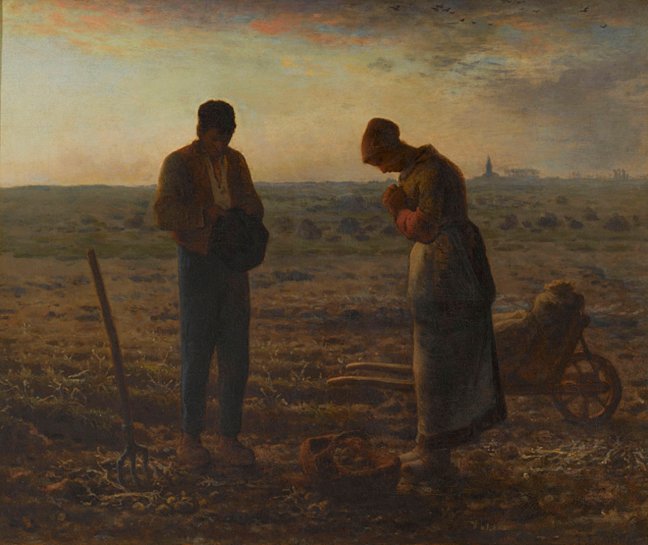
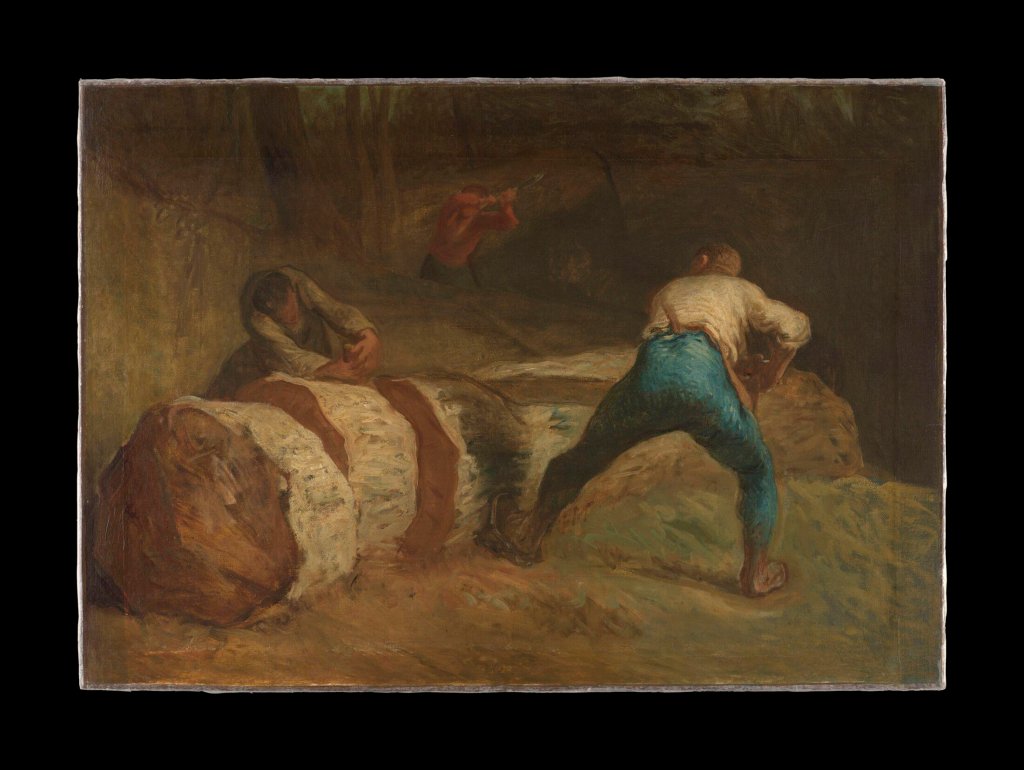
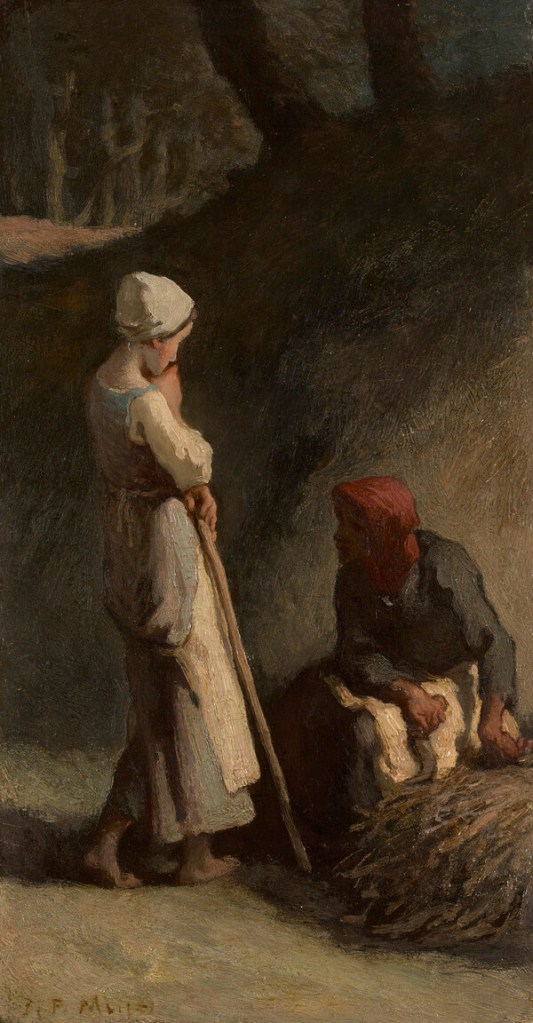
Finally, next door at the National Gallery, there’s another real gem; since it’s in just one room, it’s again for free. Don’t let the small number of paintings and drawings – around 15 – on display in Millet: Life on the Land put you off; these accounts of agricultural work by Jean-François Millet – most famous, probably, for The Gleaners (1857) – are quite simply superb. They depict rural life with a sure sense of the fatigue resulting from the peasants’ daily tasks. The Wood Sawyers (1852) shows the sheer energy, exertion and strain involved for two men at work on a tree trunk, and for a man behind them felling another; The Faggot Gatherers (1855) pairs a young woman in bare feet with an elderly colleague whose hands betray her history of harsh labour; The Well at Gruchy (1854) depicts a woman washing copper milk cans, exquisitely painted; and L’ Angelus (1859, a masterpiece on loan from the Musée d’Orsay – picture at top) captures a moment of brief respite as a man and a woman pause in their work to offer a prayer at sunrise or sunset. In all these pictures, the human subjects are given no recognisably individual features; they become everywoman/everyman figures, destined to long hours of poorly paid labour but retaining their dignity throughout. The colours are somber, the attention to detail subtle but telling, the sense of time and place, implied through light and landscape, meticulous; looking at L’Angelus, one can almost hear the murmured prayer accompanied by the bells ringing at the distant church. (Standing before it, I was put in mind of Debussy’s The Sunken Cathedral, composed half a century later.)
There has apparently been lengthy discussion about what these depictions of peasant life tell us about Millet’s political beliefs. Without reading too much into them, we can certainly see that he felt great sympathy for anyone forced to work so hard for a living; he grew up among such people, and evidently understood both the nature and the cost of such labour. Little wonder that these and other works would win an admirer in Vincent Van Gogh, whose own early ‘peasant character studies’ covered similar ground. It may fill just one room at the National Gallery, but the artistry on view in this exhibition is profoundly human and to be cherished.
The Edward Burra exhibition continues at Tate Britain until 19th October. Jenny Saville: The Anatomy of Painting continues at the National Portrait Gallery until 7th September; the Herbert Smith Freehills Kramer Portrait Award 2025 show until 12th October. Millet: Life on the Land is at the National Gallery until 19th October. Reproduction of L’ Angelus © Musée d’Orsay
* Since writing this, I have visited the Kiefer / Van Gogh exhibition which continues at the Royal Academy of Arts until 26th October, and can confirm that it too is well worth a look.
 notes and observations by Geoff Andrew