Around three months ago, I wrote about what to me seemed a fairly transformative experience of joining a local choir to sing some music by Brahms. I certainly don’t intend to post a blog after every concert I take part in – this will probably be the last – but in the hope of encouraging others who may be considering joining a choir but suspect it could be beyond them, I offer a brief update*. In the earlier post I mentioned that Beethoven could be my next task, and so it was: Beethoven’s Ninth, to be precise, famously known as the Choral Symphony because its revolutionary fourth and final moment is a setting of Friedrich Schiller’s poem An die Freude, or Ode to Joy,later hijacked as the Anthem of Europe.
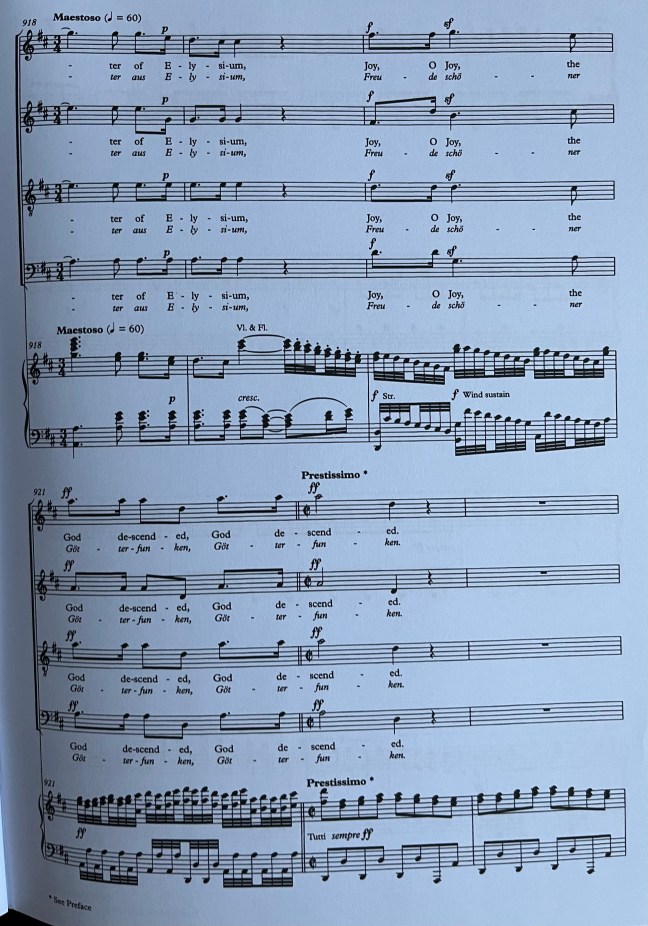
After my initially painful struggle to learn the Brahms, I thought to myself that, being less than 20 minutes long and centred on a recognisable, fairly repetitive tune I’d known and loved since my teens, the Beethoven would be a far easier task than the Requiem we’d performed in March. Well, yes… and no. It is much shorter, more repetitively melodic even for the basses, and in many ways fairly straightforward. Then again, unlike the Brahms we were singing the Beethoven in German; moreover, a couple of choir colleagues warned me that it was actually quite difficult to sing, since the composer – profoundly deaf when he wrote the piece – had included some extremely high notes for all the singers. Plus, towards the end, the music gets very fast indeed.
I decided to give it a try anyway: I went to rehearsals under our conductor Ollie Till, and put in the hours at home, sometimes singing along to CDs. Singing in the original language wasn’t that tricky, as I have a rudimentary grasp of German pronunciation, and one soon gets to learn and remember the words simply as sounds. The high notes were more problematic. At first they emerged like painfully strangulated squeaks, but over time I found that the louder I sang them, the better they sounded; I simply had to go for it. The tempi in the symphony’s closing minutes were also best dealt with by just putting aside any anxiety. After all, with such loud, rousing singing from the choir, who would hear my mistakes at the concert? Only, perhaps, the poor souls standing next to me during the performance.
As it turned out, the most important difference between singing the Brahms and the Beethoven was not so much the music itself as my own level of experience. Since the Brahms was my first experience of singing classical music in almost 60 years, I’d believed that the various challenges it presented were probably insurmountable. This time, having discovered that such obstacles could be overcome, I simply thought, when facing the Beethoven, ‘Okay, this bit is difficult, but be patient – with time and perseverance, you’ll probably be able to manage it.’
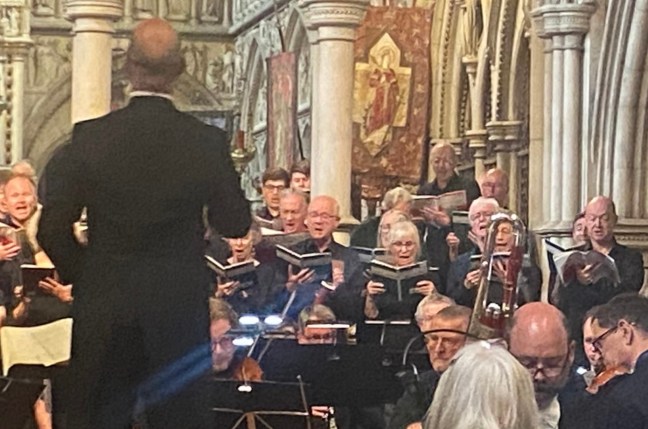
And so it proved on the day, when we Queen’s Park Singers joined with the Peregrine Orchestra and Voices under the baton of Daniel Collins, with soloists Felicity Hayward, Eleanor Kemp, Mark Dobell and Ben Davies, in the Victorian splendour of St Augustine’s, Kilburn. One friend found the church’s acoustic didn’t help the music in terms of clarity, whereas another confessed she’d been moved to tears. It was difficult for me to tell how good the performance was, partly due to our positioning behind the soloists and orchestra, partly because I was too focused on trying to get the bass part right. What I can very truthfully say is that, like other choir members I spoke to afterwards, I felt exhilarated by being part of such a joyful noise. Not only has a second term with the choir meant that I’ve got to know a few more members and come to feel more confident about my attempts to read music and my singing; it also provided, both at rehearsals and at the concert itself, a wonderful sense of belonging to a group of people creating music for the sheer fun of it. Freude indeed… and if you fancy a spot of singing, thoroughly recommended. (Had anyone told me a year ago that I would be singing this music with an orchestra, in front of an audience, I would not have believed them. But I’m very glad that I would have been wrong.)
Finally, if by any chance your don’t know Beethoven’s Schiller setting, you can watch it here with a very great conductor and some very wonderful performers, including one of my favourite baritones.
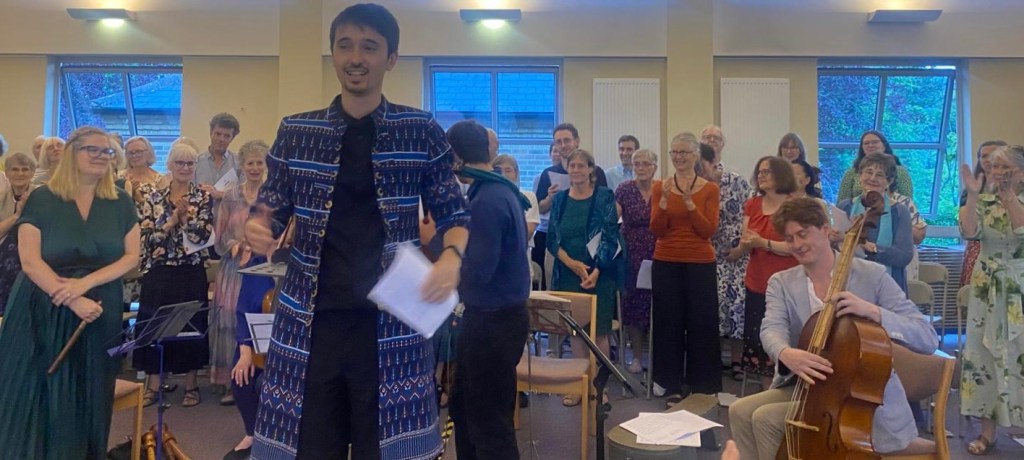
*Six days after the Beethoven concert, the Queen’s Park Singers, accompanied by a period-instrument quartet, performed John Dowland’s First Booke of Songes. Though I’d initially found Dowland’s music rather tricky in some respects and not particularly appealing, I can confirm that this concert too turned out to be a blast (see photo below, taken by Ane Roteta). Next up: Purcell.
 notes and observations by Geoff Andrew