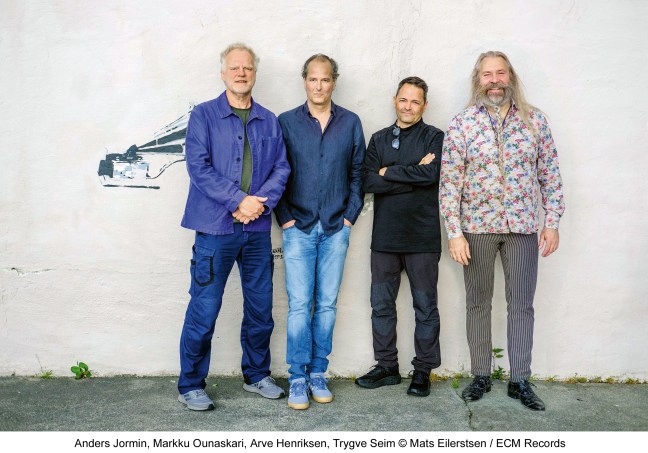
Frequent readers will probably have registered my admiration for the various musical offerings of saxophonist Trygve Seim and trumpeter Arve Henriksen, so are unlikely to be surprised by my enthusiasm for Arcanum, a newly released quartet album they made with bassist Anders Jormin and percussionist Markku Ounaskari. The four have played together in various configurations and formats over the years: Henriksen shone brightly on Seim’s first three albums for ECM – the superb Different Rivers (2000), The Source and Different Cicadas (2002) and the magnificent Sangam (2004) – while all four have featured regularly on the albums of Sinikka Langeland. But they’d never before now recorded as a quartet; still, better late than never.

Stylistically, Arcanum is quite diverse, with some tracks wholly improvised, others from compositions by Seim and Jormin, alongside a traditional hymn (Armon Lapset) and a brief, fairly forthright take on Ornette’s What Reason Could I Give?, a song from Science Fiction, arguably Coleman’s finest album. Sometimes, it’s clearly ‘jazz’; sometimes, something more chamber-like, impressionist, experimental. But in the end such categories are meaningless.
The blowsy opener, Nokitpyrt – the title alludes to Triptykon, Jan Garbarek’s third ECM release, made with Arild Andersen and Edward Vesala – feels reminiscent not only of the Norwegian maestro’s work of the early 70s but also that of the likes of Albert Ayler and Don Cherry. Some of the improvisations are, for all their concision, quite abstract, while other numbers feel more structured and traditional: Seim’s plaintive, hymnal ballad Trofast, for example, where the highly distinctive timbres of both the composer’s sax and Henriksen’s trumpet are at their most characteristically lyrical, with Jormin and Ounaskari underpinning their melodic invention with nimble, similarly expressive expertise.
That said, despite the array of tonal and textural colours, the album is for the most part mid-tempo or slower, and even when a track does build in power or pace (as in Pharao or La Fontaine), it seldom feels ‘upbeat’. Though Seim occasionally embraces a certain jauntiness, there is a wonderfully meditative, even melancholy vein to much of his playing, evocative of prayer or lament, while Henriksen too moves increasingly away from those Cherry-like squeals and squalls on Nokitpyrt and Old Dreams to something more contained and ruminative. Jormin’s Elegy is a case in point, while the album’s final tracks – most notably the measured, sometimes near-static largo of Shadow Trail and the gently tentative, finally evanescent Fata Morgana – slow things down still further. Not that the album loses creative momentum; the imaginative fecundity and the sheer beauty of the music ensure that it is never less than entrancing. The sympathetic interplay between the four musicians is remarkable; I’ve found that their album grows with each hearing, and imagine it will continue to do so.
Mention of two further recent releases is warranted. I recently wrote enthusiastically about a new album by bassist-composer Vilhelm Bromander, a name then new to me, in whom I expected to take interest in the future. I was subsequently alerted by Swedish drummer Nils Agnas (also new to me) to the imminent release of Words Were Coming Out Our Ears, a mostly improvised album featuring Agnas, pianist Johan Graden and not one but two bassists: the aforementioned Bromander and Pär Ola Landin. The format is intriguing and rewarding: while the liner note says the doubling of basses gives ‘unusual depth and weight’ – and certainly it makes for fascinating melodic and harmonic nuances – this listener, almost paradoxically, found the album pleasingly airy, open and light. Only the final track – Graden’s angular Kontradans, for which the quartet members are joined by trumpeter Emil Strandberg and contrabassoonist Katerina Agnas – sounds in any way predetermined; even a version of Kate McGarrigle’s Go, Leave feels engagingly spontaneous. You can listen to samples here.

Then there is Homage, with saxophonist Joe Lovano teaming up with pianist Marcin Wasilewski, bassist Slawomir Kurkiewicz and drummer Michal Miskiewicz, the impressive Polish trio I first heard more than 20 years ago accompanying the late great Tomasz Stanko. Somehow, despite my enduring interest in Lovano – I first encountered him in the 80s, playing with Carla Bley and Paul Motian, and I wrote about his work with Marilyn Crispell and Carmen Castaldi here – I’d managed to miss Arctic Riff, his previous collaboration with the Poles, which appears perhaps to have been driven more by Wasilewski, who composed several of the numbers featured. This time, with the exception of the opening Love in the Garden, written by the Polish violinist Zbigniew Seifert, the tracks are entirely based on Lovano compositions. The mood is generally ‘jazzier’ in feel than the Trio Tapestry albums with Crispell and Castaldi, with even the initial near-serialist spikinesss of the title track shifting to something a little bluesier. Certainly, Golden Horn, with its echoes of the riff underlying A Love Supreme, and This Side – Catville groove along fluently to very satisfying effect. If the final track, Projection, in which Lovano indulges his love of gongs, is less compelling than the rest of the album, no matter; a miniature of just two minutes, it provides a very nice sense of closure.

Arcanum and Homage are released by ECM. Words Were Coming Out Our Ears is released by Aspen Edities and available through Bandcamp. The photograph of Jormin, Ounaskari, Henriksen and Seim is by Mats Eilertsen, and that of the Wasilewski Trio by Tomasz Sikora; both are courtesy ECM.
 notes and observations by Geoff Andrew