With the perhaps partial exception of my best-of-the-year lists, my writing here has always been about what other people have done – filmmakers, musicians, artists, photographers, writers – rather than about myself. For once, however, I am going to deal with my own actions, simply because I’d like to encourage anyone out there who’s considering doing what I did recently – to my own amazement (not to mention that of others), I joined a choir – but who is understandably worried that they may not be up to it.
Prior to the last few weeks, the only time I’d given any kind of musical performance in public was as a 12-year-old treble in the Northampton Grammar School choir, 59 years ago. We sang Haydn’s Nelson Mass, and as far as I can recall, I enjoyed both the weekly choir practice and the concert itself; sadly, our (very fine) music teacher Michael Nicholas decided the next concert should be Benjamin Britten’s Noye’s Fludde. I disliked what we sang so much that I left the choir after a couple of sessions, with what seemed, many years later, regrettable consequences: not only did it put me off listening to Britten for several decades (thus ensuring I missed hearing rather a lot of good music), but it meant I never got to read music properly. I could just about follow a score (though I almost never did so after my teens), but that was about it. Apart from a brief, jokey flirtation with the guitar (strumming, and very occasionally plucking, along to my own rather pathetic songs) in my early 20s, my music-making was over and done with.
So why the change? One Sunday last summer, around the time the BFI decided to retire me from my part-time programming consultancy, I was walking through Queen’s Park; it was ‘Queen’s Park Day’, and among all the stalls selling home-made ceramics, cakes and various types of tat, I spotted one of interest, for the Queen’s Park Singers, a ‘friendly’ local choir specialising in classical music. Picking up a leaflet, I asked if one had to be able to read music. I was told it wasn’t essential but I should at least be willing to try to learn. I decided to give it some cautious consideration. I noticed that rehearsals were on Sunday evenings, and that the autumn term would work towards a concert of music by Lili Boulanger and Britten’s Ceremony of Carols. I had already booked for several unmissable concerts on Sunday evenings; that, together with the ominous Britten connection, meant that I postponed joining until after Christmas, when the new term would work towards a concert of Brahms’ Requiem. Now that would be something. (I didn’t at that time appreciate just how dense and difficult the piece is.)

By early January I’d become highly dubious about joining; I’d listened a couple of times to my CD of the Requiem and realised that it was not only very long (over an hour!) but had few easily recognisable tunes. Still, my wife and a couple of friends encouraged me to give it a try, so I plucked up courage and went along to the open rehearsal. Several people proved to be very welcoming, including the conductor Oliver Till, who got me to sing some scales during the tea break and advised me to sing with the basses; at least he didn’t hint that I should think again about joining the choir. So well and good – I decided to join – but it must be said that I spent most of the first three or four rehearsals feeling massively anxious. My attempts to read the music were still fairly forlorn, the basses get to sing few immediately recognisable melodies but mainly provide harmonies for the higher voices, and I was mostly trying to sing as softly as possible so that my neighbours wouldn’t hear my mistakes.
But one of the basses gave me tips about the learning aides provided by the choir – audio links which give you the line for your own particular part, to sing along with at home – and several members, when I mentioned how terrified I was so far, assured me that at some point in the future something would suddenly ‘click’ and I would by then know the work well enough to be able to sing it while following the score. I didn’t really believe them, but I put in quite a few hours’ practice at home each week, making notes on a sheet of paper along the lines of ‘3rd movement, bars 163ff very tricky, the ending IMPOSSIBLE!!!’ I seriously considered leaving the choir after the third week, but reminded myself that I was now able to follow the score a little better than before, and that countless other people have been able to sing the piece, so why on earth shouldn’t I too be able to overcome any obstacles? I stuck in there. Kind friends – a couple of them in choirs themselves – reassured me I was right to do so. One suggested I try taking a short singing lesson. Again – it was considerably less expensive than I expected – I plucked up the courage, did so, and saw some (to me, at least) surprising improvement.
I sensed that I felt less anxious if I sat next to the same people for each weekly rehearsal – the other choir members tended to do this – but then came a moment when we had to head over to Hampstead to rehearse with the Royal Free Music Society choir, who would be singing with us at the concert in March. Not only was I now faced with the RFMS conductor, Benjamin Wolf, whose methods were slightly different from Ollie’s, but I was also seated next to likewise unfamiliar singers. Imminent panic attack! But nothing awful transpired, and I even found myself feeling not quite as flustered as usual by one of Brahms’ worryingly long, complex and repetition-light fugues. The next week – by which time we’d practised all seven movements at least once – that ‘sudden click’ came; we were in the middle of another long, complex, repetition-light fugue when I noticed that the choir as a whole was singing it rather better than before, and that I myself was finally singing it correctly… and, moreover, almost as loudly as I should, without fear, shame or embarrassment. I also realised that I was enjoying it; to misquote the fugue that ends the third movement, ‘No more pain touches me now’*. Even as I was singing out, I felt a strange, strong surge of emotion in my chest; not only was I singing Brahms (what? a miracle in itself!) but I was an integral part of a loose community committed to music-making, not for profit or career purposes but for the sheer fun of it. To quote the Requiem again, ‘Blessed are they…’
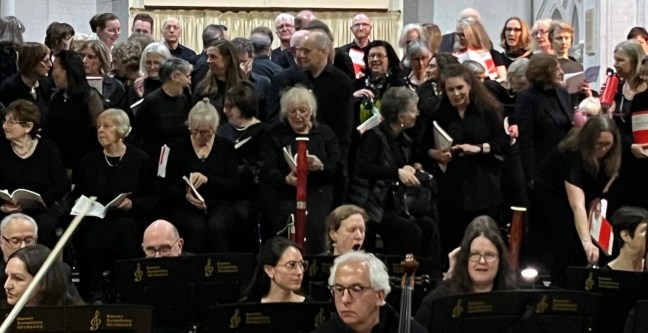
Thereafter, for all my fundamental shyness, I was no longer anxious about rehearsals but looked forward to them, including the first with the Barnet Symphony Orchestra in St Mary’s Primrose Hill, the church where the concert would be performed two weeks later. I positioned myself between the two basses whose voices I knew and trusted, and sang out as best I could. I was still making the very occasional mistake, but no one seemed to notice or mind enough to say anything. During the next fortnight, I made a point of going through the whole Requiem at home six or seven times, twice singing along to my CD (yes, I’ve sung with Rattle and the Berlin Phil!). Finally, the big day came, and our encounter not only with soloists Angus McPhee and Elinor Jane Moran but with an audience: a dress rehearsal where I tried to sing – with only partial success – looking up at Ollie Till conducting rather than down at the score, and then the evening concert itself, where my success rate in that regard was considerably higher. (You can just see me in the picture above, right at the back in the centre, before the concert began.) The singer on one side I was familiar with, the one on the other side less so, but no matter; this was all about singing together. I made, I think, three or four minor mistakes during the performance, but I doubt anyone noticed, and besides, the perfectionist in me notwithstanding, I had a wonderful time. I sang out confidently in music which only two months previously had confused and terrified me, but which I had now come to know, understand and deeply love. (And like the Nelson Mass, the Requiem is now firmly embedded in my consciousness; I may never get to forget it…)
Why write at length about all this? Partly because the whole process has been one of my most challenging, enlightening, rewarding experiences in recent years; transformative, too – I’ve gone from timidity and anxiety to confidence and exhilaration, and the hope that I’ll be doing more such singing in the future. (Beethoven next, if all goes to plan.) Partly because I’d like to thank each and every person who has encouraged and enabled me to go on this journey; if you’re reading this, you surely know who you are. But also partly because I imagine there may be others reading this who, like me, have occasionally wondered about doing something or other in the realm of making music – after all, music matters so much to so many of us – but who suspect it might be beyond them. Well, it may turn out that it isn’t anything of the sort. Perseverance, a little courage and a desire to be a part of something creative and uplifting – those can help enormously in making actual what may at first appear impossible. If you have ever thought along those lines, you should maybe give it a try.

*We were singing Brahms’ Requiem in English translation. Though the piece is often referred to as ‘A German Requiem’ (because he had chosen to set as his text fragments from Luther’s German translation of the Bible, rather than words of the usual Latin mass), Brahms himself attached no importance to its nationality and stated that he would happily have titled it ‘A Human Requiem’.
 notes and observations by Geoff Andrew