
The recently opened exhibition at the Courtauld – Goya to Impressionism: Masterpieces from the Oskar Reinhart Collection – may include only around two dozen paintings, and its title may be a tad misleading: there’s just one Goya on show, and the show has very little (as far as I can tell, anyway) to say about the development of painting from the time of the Spanish master to that of Cézanne, Monet and Renoir. Indeed, the subtitle is more illuminating: the pictures on display are all from a museum near Zurich which houses works collected by Reinhart, a contemporary of Samuel Courtauld who appears to have shared his tastes in art. What’s most important about this exhibition, at least for a layman like myself, is not any ‘story’ about its provenance or any subtle motif linking the various pictures, but the sheer quality of the works on show. Also, there’s the fact that it’s not been possible to see them in Britain until now; only recently have paintings from the collection been allowed to travel.
So there’s only one Goya, but Still Life with Three Salmon Steaks (1808-12, picture above) is undoubtedly worth discovering. I’m not sure one needs to make too much of the fact that the viscerally effective lumps of blood-tinged flesh were painted during the Peninsular War; suffice, surely, to note the vividness and virtuosity of the work, the pink meat and silvery skin rendered all the more dramatic by being isolated against a monolithic black background. Only the grey stone surface on which the steaks lie is suggested; all further detail is avoided. It’s a suitably forthright introduction to a first room which also includes an exquisite picture of a girl reading by Corot; one of Daumier’s lovely variations on Quixote and Sancho Panza; a stormy study of a breaking wave by Courbet; and an unusually fine early portrait by Cézanne of his uncle.

Best for me, however, was Géricault’s A Man Suffering from Delusions of Military Rank (c1819-22). While there is apparently some debate about the purpose and precise circumstances surrounding the artist’s painting of this and other studies of people suffering from mental illness, there is no doubting the compassion and humanity of Géricault’s account of a gaunt, elderly man lost in thought; if the subject was prone to ‘monomania’ (as a certain kind of obsessively delusional behaviour was then termed), his face and bearing are nevertheless conspicuous for their intelligence and dignity.
It’s in the second room where Impressionism comes into its own, accompanied by an early Picasso portrait, an early and far from characteristic Gauguin landscape of roofs in Rouen, and two Van Gogh pictures of the hospital in Arles he stayed in at the end of 1888. There are a few Renoirs, my favourite being his 1876 portrait of Victor Chocquet, a customs worker who despite a modest income provided sterling support for Renoir and the Impressionists; it’s an engagingly intimate picture where you can really feel the connection between the painter and his subject. And there is a truly wonderful Monet from 1880-81 showing the breaking up of the ice on the Seine during an unusually cold winter.
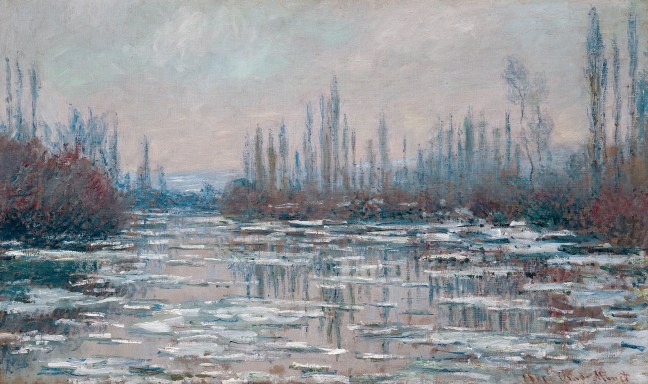
There are some intriguing Manets, a flamboyant picture of a clown by Toulouse-Lautrec, and a compelling picture of barges on the Canal Saint-Martin by Sisley. But the most impressive group of paintings in the exhibition are surely those by Cézanne. Besides the aforementioned early portrait, there is a fine still life of fruit and a jug, a wonderfully fluid watercolour of female bathers, and three marvellous landscapes. I was very taken by The Château Noir (1885), in which the titular Gothic folly is barely visible through dense foliage; the predominance of greens and the framing trunks and branches place us firmly in the forest, so that the building itself remains an elusive, faintly mysterious presence beyond our reach.
And then, of course, there is a picture of the artist’s beloved Mont Sainte Victoire, in this case a large and quite stunning watercolour from 1902-06. The distant mountain, beyond a multicoloured plateau of trees, fields and buildings, is deftly conveyed by a blend of light blues and blank patches; the suggestion is of sweltering heat and of Sainte Victoire as an enduring elemental presence which dominates everything that surrounds it. Like several other pictures on display in this show, this is surely a masterpiece.

Modest in scale the exhibition may be, but one can of course complement its contents by seeing appropriate pictures by the same artists in the Courtauld’s permanent exhibition. And if you simply want to catch some great art that will be returning to its Swiss home in May, now’s your chance.
Goya to Impressionism: Masterpieces from the Oskar Reinhart Collection continues at the Courtauld until 26 May 2025.
 notes and observations by Geoff Andrew