
If by any chance you read my recent ‘best of 2024’ post, you may have noticed, among the new musical releases, the inclusion of an album entitled Relations, attributed to Thomas Strønen, Craig Taborn, Chris Potter, Sinikka Langeland and Jorge Rossy. That would be a rather eccentric line-up for a group – a Norwegian percussionist, an American pianist, an American saxophonist, a Norwegian singer and kantele-player, and a Spanish percussionist-pianist. But such a band doesn’t exist, since the album consists almost entirely of duets, in which Strønen (who contributes two solo tracks) is accompanied on two tracks each by Taborn and Potter, and on three each by Langeland and Rossy. That’s an unusual format for an album, but actually it’s even more intriguing that that. Only after I’d listened to the album several times, enjoying it a great deal, did I learn of its unusual genesis, whereby none of the duets was recorded with the performers in the same studio. Indeed, they weren’t even playing at the same time. Which may call into question some of our assumptions about musical interplay.
When interplay is mentioned, we’re usually talking about something created by a minimum of two musicians performing together, simultaneously and spatially. Whether in classical, folk, jazz, pop, experimental music or whatever, we often enthuse about the creative spontaneity of response between two (or more) musicians coming fruitfully together in an expressive use of shared space and time. That Relations has all the qualities of interplay we hope for from duets belies the circumstances of its making.
Back in 2018, Strønen – whom I first heard in the mid-2000s on a couple of Rune Grammofon albums by Food, a fine outfit co-led by the percussionist and saxophonist Iain Ballamy, and at that time featuring Arve Henriksen – finished recording a trio album ahead of schedule; ECM producer Manfred Eicher suggested he use the remaining studio time to make some solo recordings. They later decided to bring others into the creative process, but the pandemic struck. Strønen suggested he send some recordings to musicians who could respond as they saw fit; Eicher suggested sending them only to people the percussionist hadn’t yet worked with. Each of the four musicians who contributed to Relations reacted differently. Recording in New York, Taborn decided not to listen to Strønen’s recordings but to improvise in the moment; also in New York, Potter listened first before recording his responses; in Oslo, Langeland committed her Strønen pieces to memory before adding voice to one track and kantele to all three; while in Basel, Rossi, a percussionist himself, replied with multiple versions on drums, vibraphone and piano, Strønen then opting to use the last.
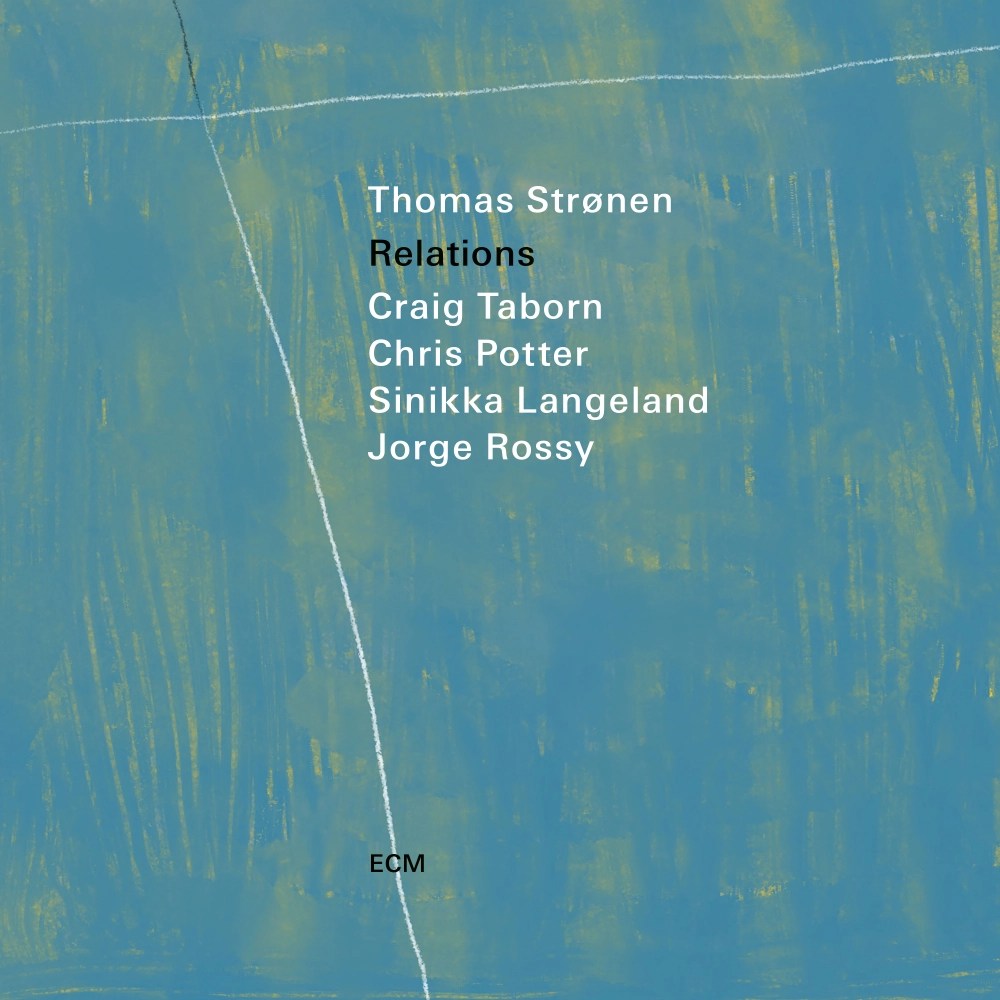
The results, mixed in 2023 by Strønen and Eicher in Munich, could easily have been incoherent, even chaotic, but they undoubtedly aren’t. The album is inevitably (and pleasingly) varied – Taborn thoughtful, mercurial, dazzling, always appropriate; Potter prayer-like, forthright, forceful or ecstatic; Langeland lyrical, elemental, sparkling, somehow timeless; Rossy with a percussionist’s sure sense of space, timbre and dynamics – as are Strønen’s originals (including his two solos), But these terrific musicians are all alert to the many nuances that can be achieved by the imaginative juxtaposition of two instruments, and it’s that sensibility that holds Relations gloriously and compellingly together. It’s an album packed with subtlety and surprise, a product of open-minded curiosity and creative empathy. In short, despite its unusual provenance, it works.
Obviously, many labels have released adventurous duet albums – some of my favourites when I was first getting into jazz were Ornette Coleman’s Soapsuds, Soapsuds (1977) with Charlie Haden, and Haden’s own three duet albums from 1976: Closeness (with Coleman, Alice Coltrane, Keith Jarrett and Paul Motian), As Long As There’s Music (with Hampton Hawes) and The Golden Number (with Coleman, Hawes, Don Cherry and Archie Shepp), on Horizon and Artists’ House. That said, ECM, reflecting Eicher’s intelligent audacity and disregard for formulas, boundaries and barriers, has made duets something of a speciality; indeed, one of the label’s first critical and commercial successes was Chick Corea and Gary Burton brought together on 1972’s Crystal Silence. Perhaps inevitably, my enjoyment of Relations got me thinking about some of the ECM duet albums I’ve especially loved, so here, in order of their release, is a list of 20 favourites, illustrating the generic variety, instrumental range and formal riches of what can be done with two musicians listening and responding to one another carefully and imaginatively. You’d sometimes be hard pushed to say whether the music here is jazz, folk, country, sacred, chamber, free, avant-garde or even ‘world’ – much of it transcends easy categorisation – but the interplay in each instance is very present and rather more than correct. If you feel a little adventurous yourself, these are all worth checking out.
El Corazón(1982) – Don Cherry (pocket trumpet, piano, melodica, doussn’gouni, organ) and Ed Blackwell (drums, wood drum, cowbell). Sample here
Atmos (1993) – Miroslav Vitous (bass) and Jan Garbarek (tenor and soprano saxophones). Sample here
Go Together (1993) – Carla Bley (piano) and Steve Swallow (bass). Sample here
Poros (1998) – Dominique Pifarély (violin) and François Couturier (piano). Sample here
In cerca di cibo (2000) – Gianluigi Trovesi (clarinets) and Gianni Coscia (accordion). Sample here
Gurdjieff and Tsabropoulos: Chants, Hymns and Dances (2004) – Anja Lechner (cello) and Vassilis Tsabropoulos (piano). Sample here
Senderos (2005) – Dino Saluzzi (bandoneon) and Jon Christensen (percussion). Sample here
The Third Man (2007) – Enrico Rava (trumpet) and Stefano Bollani (piano). Sample here
Elixir (2008) – Marilyn Mazur (various percussion, tuned and untuned) and Jan Garbarek (tenor and soprano saxophones, flute). Sample here
Chiaroscuro (2009) – Ralph Towner (classical, 12-string and baritone guitars) and Paolo Fresu (trumpet, flugelhorn). Sample here
Jasmine (2010) – Keith Jarrett (piano) and Charlie Haden (bass). Sample here
Pastorale (2010) – Stefano Battaglia (piano, prepared piano) and Michele Rabbia (percussion, electronics). Sample here
One Dark Night I Left My Silent House (2010) – Marilyn Crispell (piano, soundboard, percussion) and David Rothenberg (clarinet, bass clarinet). Sample here
Hagar’s Song (2013) – Charles Lloyd (tenor and alto saxophones, bass and alto flutes) and Jason Moran (piano, tambourine). Sample here
Transylvanian Concert (2013) – Lucian Ban (piano) and Mat Maneri (viola). Sample here
The Transitory Poems (2019) – Vijay Iyer (piano) and Craig Taborn (piano). Sample here
Glimmer (2023) – Nils Økland (Hardanger fiddle, violin) and Sigbjørn Apeland (harmonium). Sample here
Touch of Time (2024) – Arve Henriksen (trumpet, electronics) and Harmen Fraanje (piano). Sample here
Outpost of Dreams (2024) – Norma Winstone (voice) and Kit Downes (piano). Sample here
Our Time (2024) – Trygve Seim (soprano and tenor saxophones) and Frode Haltli (accordion). Sample here
So what about that teaser title of it taking two to tango? For that particular form, you might like to try Ojos Negros (2007), by the aforementioned Dino Saluzzi and Anja Lechner. We haven’t even gone down the classical path, but that’s another story.
Thomas Strønen’s Relations is out now on ECM. Photo of Thomas Strønen at top courtesy of ECM.
…..
T
 notes and observations by Geoff Andrew