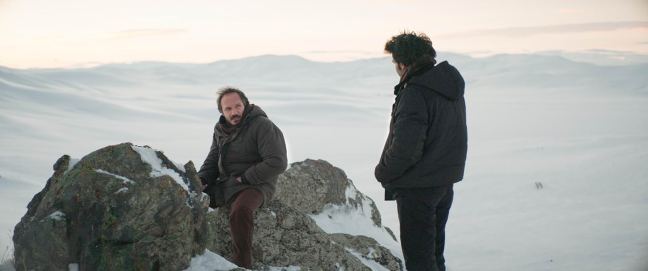
Now in UK cinemas and by far the finest fiction film I’ve seen this year, About Dry Grasses is utterly characteristic of the longer, more recent works by the great Turkish writer-director Nuri Bilge Ceylan; at the same time it’s so engrossing throughout that it feels remarkably fresh from beginning – a brazenly Ceylanesque long shot of a man getting off a bus in the middle of nowhere and trudging towards the camera through a snowy rural landscape – to wonderfully ambiguous end. True to form, it’s quite long (three and a quarter hours), leisurely in its pacing, visually very beautiful, and packed with conversations rather than big dramatic action. (That said, compared to the Palme d’or-winner Winter Sleep, it has quite a momentum.) It’s also consistent thematically with Ceylan’s earlier work, since it centres on a faintly cynical intellectual less than content with his lot in the provinces. No matter if all this sounds familiar; the movie is a masterclass in subtle, insightful, moving and wholly cinematic storytelling, and generously rewards every second of the close attention it deserves.
It’s set in a village in wintry Eastern Anatolia, where Samet (Deniz Celiloğlu) is serving out his term as a teacher; keen to move to Istanbul, he despises his current posting as a tedious, culturally conservative backwater unappreciative of his talents, though he gets on well enough with his colleague and housemate Kenan (Musab Ekici) and enjoys the respect of several smart pupils, especially the lively Sevim (Ece Bagci). This last relationship backfires, however, when a lie on his part results in him and Kenan being accused of inappropriate behaviour – a charge that has various unforeseen consequences, not only for the two men but for Nuray (Merve Dizdar, whose performance won the Best Actress prize in Cannes last year), a teacher posted to a nearby town whom the pair befriend.
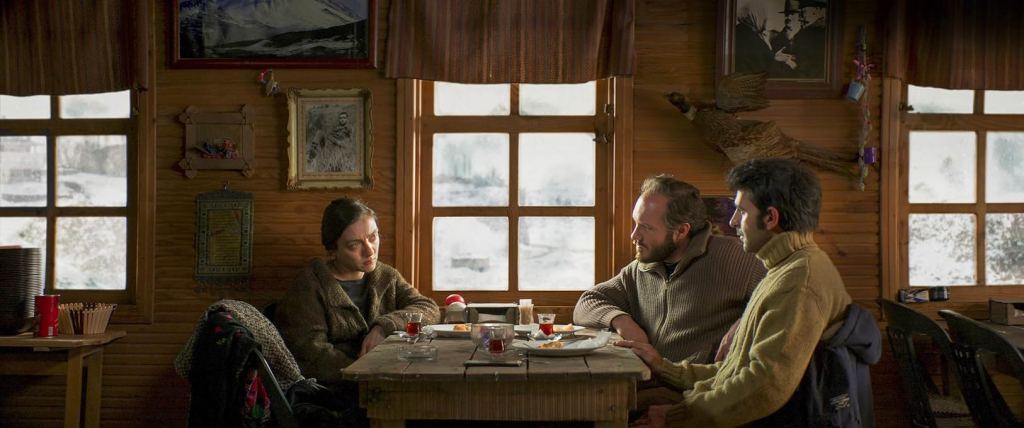
Though all these four – and indeed all the other major characters – are brought to vibrant life by superb writing (by Ceylan, his wife and long-term collaborator Ebru Ceylan, and Akin Aksu, on whose experiences as a teacher stationed in provincial Turkey the narrative apparently draws) and marvellous performances, the main focus throughout is on Samet, a fascinating, very credibly complex individual. Ever since early works like Clouds in May, Distant (Uzak) and Climates, Ceylan has been an expert observer of male pride, insecurity, cowardice and arrogance, and Samet is one of his greatest creations yet, whether wordlessly watching and listening to others or arguing ethics, politics, art or whatever with friends, colleagues or pupils.
While there’s a lot of sly humour in the film, there is also a sobering awareness of humanity’s capacity for hypocrisy, deceit, delusion and destruction. Ceylan’s extraordinary achievement is to gradually peel away the protagonist’s facade of fairly playful, liberal sophistication to reveal layers of bitterness, envy, vengefulness, even bullying brutality, while ensuring that we take a compassionate interest in him; even more remarkably, towards the end we get to hear some of his innermost thoughts, offering a fresh if still deluded and perverse perspective on what’s happened. Deep down, beyond all his rants about the drawbacks of living and working in a shithole, is Samet suffused with self-loathing? Or will he always blame others for his misfortunes? The virtue of About Dry Grasses is that it insists life is far more complicated than that.
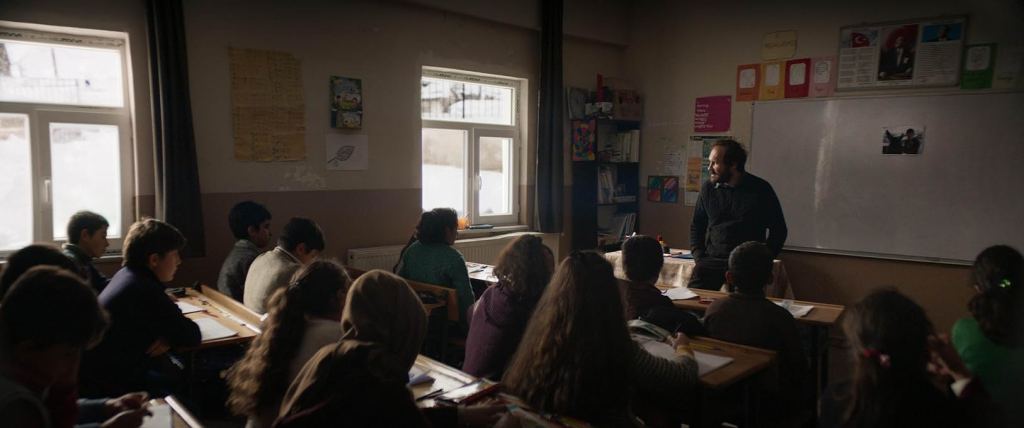
It’s become something of a cliché to describe Ceylan’s later, longer films – Once Upon a Time in Anatolia, Winter Sleep and The Wild Pear Tree – as novelistic or Chekhovian. That said, Ceylan has openly acknowledged the influence of 19th-century Russian literature, even going so far as to include, now and then, Chekhov in his closing credits, and here we can surely discern Pechorin, the protagonist of Mikhail Lermontov’s A Hero of Our Time, as one source of inspiration. (At one point, intriguingly, Samet even asks if everyone should try to be a hero.) Certainly, About Dry Grasses is philosophical in its musings, just as it’s quietly but suggestively political in its resonance: Nuray, an activist, has been injured by a suicide bombing, the army are never far away, and Ataturk’s name and picture keep cropping up. It’s a film at once profoundly evocative of time and place and, like all great cinema, acutely conscious of the complex mysteries of being alive.
There is so much more to be said about this ambitious, audacious and deeply affecting film. I haven’t even touched on the use of the Ceylans’ own photographs, on a wholly unexpected development at a crucial point in the narrative, or on the expert staging of the unusually credible scenes featuring fiery arguments. I leave you to discover (and ponder) those and many other pleasures for yourself. One final thing, though: don’t be put off by that title. Dry the film most certainly isn’t.
 notes and observations by Geoff Andrew
I’m a big fan of Nuri Bilge Ceylan especially the later, longer films and I’m looking forward to: About Dry Grasses. Could you tell me: did you see this at the cinema or is there a DVD or streaming option available? Thanks
LikeLike
I did see it in a cinema, with a nice big screen – best by far if you can manage it.
LikeLike
Excellent review of an excellent movie. I had a knot in my stomach when it finished (and for days after) I loathed the main character so much but I couldn’t look away.
The one personal gripe for me is that movies today are shot on digital. I saw About Dry Grass in the cinema with a large receptive audience and as good as it was seeing it like that I found it hard to relax because of the mega sharp, scrubbed, digital image. I saw Greta Gerwig’s Little Women at the cinema and could feel my mind relaxing before it registered it was shot on film.
LikeLike
Many thanks for your kind words, and glad you liked the film. I myself don’t have a problem with digital cinema, and I know many filmmakers who are very happy that they now have greater control over the image and that their work will no longer be be going around in battered, scratched, faded or incomplete prints.
LikeLike