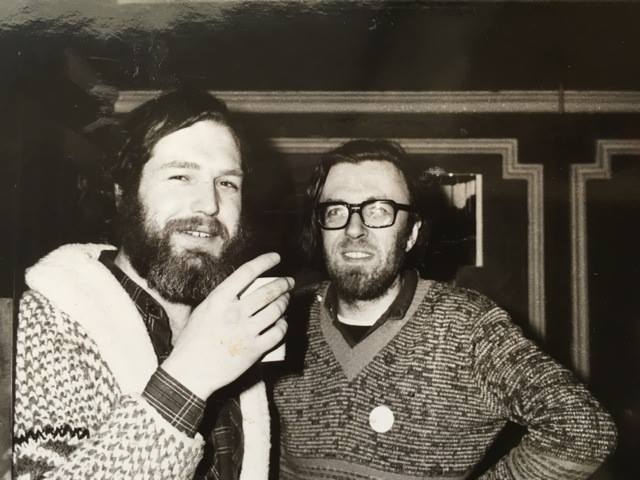
The first time I encountered Peter Howden was shortly after I moved to London in the autumn of 1976. I had moved into a seedy basement flat in Westbourne Park, and the similarly seedy Electric Cinema Club, five minutes’ walk away in Portobello Road, soon became my second home. There was a bearded, bespectacled guy there, probably in his early 30s, who sometimes tore your ticket or sold you a coffee; he didn’t say much (though he did sort of smile), and it was only two or three months later, when I went to be interviewed for a managerial job I’d seen advertised in Time Out, that I discovered he was not just a member of the front-of-house staff but the programmer and, indeed, the director of the Electric. That was the first surprise; the second was that he gave me the job – 22 years old, little more than six months out of university. I had, I knew, a hell of a lot to learn.
Learn I did, largely from Peter. I soon found that being the manager of the Electric meant following in Peter’s footsteps in terms of multitasking. I managed the staff but also tore tickets, sold coffee, made sandwiches, cashed up at the end of the day, changed (sometimes drew) the foyer posters, carried film cans up and down from the projection box, dealt with the public, tried to keep out drunks and addicts, stood in when projectionists were late arriving, fed the cat, etc, etc. Most of that felt okay – though the drunks and addicts were a pain – because Peter had done it too, ever since he set up the Electric Cinema Club in the late 60s. It was unconventional – the building, run-down and underfunded, was widely regarded as a fleapit, and my parents couldn’t understand why I wore a leather jacket at work rather than a suit – but that was also okay, because like Peter, most Electric staff worked there, for a pittance, because they loved films. Watching films, talking about films, reading about films – in some cases (though not mine) trying to make films. – was what it was all about.
I set about learning, avidly. The Electric showed about 25 films a week, and I watched as many as I could. But I also spoke as much as I could with Peter – a deeply private man – about movies; only then would he really open up with opinions and thoughts on all kinds of cinema. If memory serves, he’d been involved in the film society at the University of Sussex before coming to London and landing a job at Contemporary Films – then Britain’s biggest and most influential distributor of world cinema – where he indulged his voracious appetite for movies. But that wasn’t enough, so in the late 1969s he and some friends started programming late-night shows at the failing Imperial Cinema; their screenings were so successful that they were soon able to take over the venue full-time, restoring its original name of The Electric Cinema. Peter’s colleagues moved on but he remained, devising a distinctly idiosyncratic, wide-ranging programme which not only offered a great alternative to that of the BFI’s state-supported National Film Theatre, but established a format soon imitated by other independent repertory cinemas like the Scala, Rio, Ritzy, Penultimate Picture House and others. (I imagine Steve Woolley and Clare Binns might both acknowledge a debt.)
In his own taciturn way, Peter was very generous. He soon allowed, perhaps encouraged me to write the notes for the Electric’s programme brochure, and not long afterwards let me take a share in the programming. I learned a great deal from his approach to that task, which looked for intriguing connections between films to form double-bills. Famously, he had once supported a revival of The Battle of Algiers by coupling it with the Marx Brothers’ Duck Soup; while other programmers might simply play two films made by the same director or starring the same actor (or even, woefully often, two films from the same distributor with titles that shared the same initial letter), Peter would seek out more interesting links. I was certainly not alone in trying to do something similar, though few did it as well as Peter.
I worked alongside Peter for around five years, by which time he was spending more time at the Hampstead Everyman, which he would manage and programme from 1981 to 1998, and I was keen to move into writing about film. When I started contributing freelance reviews to Time Out, I was often sent to the Everyman to check out some rarity he’d found a print of. He was still a man of few words, but at least those words – often delivered with a dry, wry wit – about the movies he was digging up were insightful and illuminating. He was not only enormously knowledgeable but had great taste; he knew that what mattered in the end was not so much what a film was about as whether it was well made; whether it succeeded in doing whatever it set out to do imaginatively and eloquently.
When Peter left the Everyman for the Rio, our paths crossed less frequently. I never quite knew whether he was the projectionist or programmer; perhaps he never lost his habit of multitasking. In recent years, he came along to a few reunion dinners attended by half a dozen old Electric staff (by old I mean both former and aged) – in Portobello Road, naturally; the last time I saw him was on one such occasion a few weeks ago, just before Christmas. Though shorter and greyer-haired than when I first encountered him, in many ways he looked and sounded very much the same. He didn’t say a lot, but he made every word count.
Though, almost half a century ago, I spent hours with Peter at the Electric, went a few times to his place to watch movies when he acquired, before anyone else I knew, a video recorder, and even shared a flat with him for a week at the 1980 Edinburgh Film Festival, I never got to know very much about him other than his abiding passion for films. (Only the day after his death did I at last discover his age and his birthday, a week or so after my own.) We generally got on well, but it would be wrong to claim we were ever ‘close’. Still, in his own profoundly reserved way, he had a major influence on my life. He gave a callow Classics graduate a job as manager of his cinema, recognising a fellow cinephile and sharing his knowledge and love of the movies; unwittingly, he helped me to embark on a half-century career of programming, writing and lecturing about film, for which I am sincerely grateful. I’m sure I am not alone in that; for all his reserve and modesty, he was a hugely significant figure in London’s film culture of the late twentieth century. He will surely be remembered with respect and affection – and missed, of course. RIP.
The photo at the top is of yours truly (I know, I know…) with Peter at a party celebrating the Electric Cinema’s refurbishment in the late 1970s. You can hear a fascinating interview with Peter here, where he waxes lyrically and at length (mainly about projection, rather than programming or running a cinema); it covers quite a few many memories he never told me about. You can also read about his time at the Everyman Cinema here, and find out more about him and The Electric at https://www.electriccinemaclub.com
 notes and observations by Geoff Andrew