What with Arve Henriksen and Harmen Fraanje soon to appear at the London Jazz Festival, I’ve been revisiting their album Touch of Time, together with a more recent release featuring the great Norwegian trumpeter performing alongside Danish drummer Daniel Sommer and Swedish bassist Johannes Lundberg. Sounds and Sequences is apparently the second album in a trilogy Sommer is putting together to explore different facets of improvised Nordic music. (The first, As Time Passes, which I haven’t yet heard, saw Sommer partnered with guitarist Rob Luft and bassist Arild Andersen.) All three musicians carry equal weight and play superbly on the new album, but perhaps inevitably it’s Henriksen’s immediately recognisable trumpet – a sound seemingly unique unto himself – that serves to define Sounds and Sequences’ luminous musical colours.

Sometimes suggestive of a Japanese flute, sometimes of the human voice (listen to Ego Ekko), sometimes of something unearthly – and even, now and then, sounding like a trumpet – Henriksen’s soft, rounded, engagingly unemphatic sonic explorations combine beautifully with Lundberg’s bass – whether plucked or bowed – and Sommer’s crisp, delicate, subtly driving percussion, not to mention atmospheric, unflashy electronics courtesy of Henriksen and Lindberg. The trio met for several improvisatory recording sessions in Gothenburg over a period of nearly two years; they then sorted through, shaped and refined the material until each of the 11 pieces included on the album felt as if it had a kind of direction or narrative.
The results, which manage to feel at the same time both spontaneous and thought-through, are pleasingly varied but utterly coherent. The slow, stately Blue-Seven, for example, feels hymnal, occasionally faintly mournful, whereas the title track builds steadily from a gentle, relaxed groove to something stormier, with Henriksen alternating yoik-singing and his soaring trumpet to exhilarating effect. I’ve mentioned how his trumpet can sound like someone singing; on Beautiful Daisy, his memorably childlike falsetto blurs the distinction between musician and instrument still further. (At a concert I attended in Stockholm last year, his performance even featured some terrific throat-singing; his range and versatility rare quite remarkable.) In short, Sounds and Sequences is an album to savour.
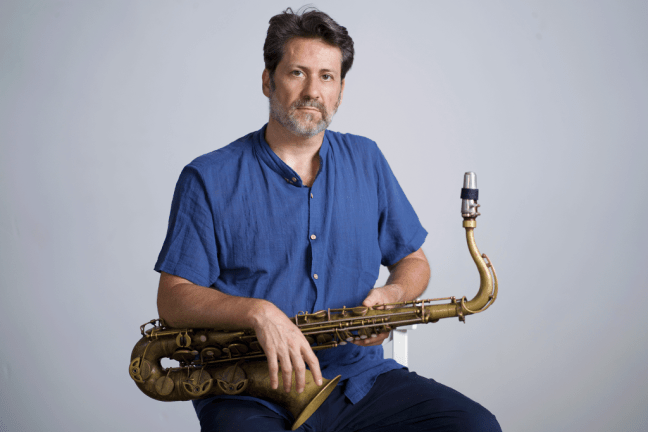
While Henriksen is one of my favourite ‘jazz’ musicians at work today (though, as often, that term doesn’t really convey the flavour of much of his work), the late Ornette Coleman has for decades been one of my favourite musicians, full stop. So I was enormously interested to learn of the recent release of Back to the Land by Ohad Talmor, a musician I’d never heard of until the double album in question. An American-Swiss saxophonist and composer with a classical background who counts the late Lee Konitz not only as a special mentor but as a frequent collaborator, Talmor found some tapes among the altoist’s possessions after his death; they had been recorded during rehearsals in 1998. Konitz had been playing some then new Coleman compositions in the latter’s loft, along with Ornette’s long-term collaborators, bassist Charlie Haden and drummer Billy Higgins. Intrigued by this discovery, Talmor set about transcribing the tunes played by the informal quartet; the glorious result is Back to the Land.
Of the 24 tracks on the album, only three Coleman compositions (Kathelin Grey – misspelt as Kathlyn Grey – New York and Peace Warriors) were hitherto available (on Song X, Prime Time/Time Design and In All Languages, respectively). Two more, Dewey’s Tune and Mushi Mushi, were written by Dewey Redman, a friend and long-term associate of Coleman who also happened to be Talmor’s first saxophone teacher. Then there are four Talmor originals, which find him adding electronics to the conventional instruments. Then there are 15 tracks which are Talmor’s versions of the recently rediscovered Coleman tunes, most of them ‘variations’ composed for trio – with bassist Christ Tordini and drummer Eric McPherson playing alongside Talmor’s tenor – but with others composed for quartet, quintet, sextet or septet, the additional musicians being Joel Ross on vibraphone, David Virelles and/or Leo Genovese on piano, Shane Endsley and/or Russ Johnson or Adam O’Farill on trumpet, and Grégoire Maret on harmonica.
Yes, you read it correctly: harmonica. Indeed, while we’re at it, yes too for vibraphone and piano. And for various electronic instruments, at least on the second album. So this is emphatically not a Coleman tribute band performing hollow pastiche. Apart from anything else, Talmor, on tenor throughout rather than on Coleman’s favoured alto, doesn’t try to sound like Coleman. And yet…
Back to the Land is wholly in keeping with the spirit of Ornette’s music, even if it can stray from the letter. The trio tracks probably come closest to what most people would consider the classic Ornette sound – if we’re talking the Atlantic recordings – but then there’s material here which also put me in mind of later albums like Science Fiction (Quartet Variations on Tune 8); Skies of America (Three Septet Variations on Tune 1); or Free Jazz or some of the Prime Time releases (Four Sextet Variations on Tune 4). Don’t let those formal titles put you off; this is music of great intelligence, for sure, but also of great sensitivity and feeling. As with Ornette, you can often hear the blues behind all the innovation; that, perhaps, is especially true of the final Quintet Variations on Tune 10, where Maret’s harmonica matches the leader’s tenor in its affecting eloquence.
(I’m sadly able to offer you as a sample only the opening track, Seeds – or you might like to catch a little bit of Talmor and co playing an Ornette-derived number on YouTube.)
So is Back to the Land an Ornette album? Of course not. But grounded as it is in Talmor’s profound love and respect for Coleman’s genius – a genius that embraced both out-there experimentation and an extraordinary emotional directness – and boasting a roster of hitherto unfamiliar Coleman tunes as its musical starting-point, it is undoubtedly an album that should be of interest – and, probably, of considerable pleasure – to anyone who, like me, misses the regular arrival of new releases by the late great man himself. I for one wholly recommend it.

Sounds and Sequences is released by April Records. Back to the Land is released by Intakt Records. Portrait of Ohad Talmor by Francesco Fedeli, courtesy Intakt Records. Photo of Arve Henriksen by Caterina Di Perri, courtesy ECM Records. Photo of Ornette Coleman at Heidelberg in 1988 by Frank Schindelbeck.
 notes and observations by Geoff Andrew
Like you, I had not heard of Ohmad Talmor but on your recommendation have bought his ‘Back to the Land’ set; many thanks for the tip.
I was at the Arve Henriksen & Harmen Fraanje concert at Kings Place on Friday; it was a superb performance (as was the following evening’s appearance at the venue of Alice Zawadzki, Fred Thomas and Misha Mullov-Abbado). If you haven’t had a chance to hear it yet, I can’t recommend the Arild Andersen, Daniel Sommer and Rob Luft album highly enough.
Finally, there is a fine album by Gregoire Maret on ACT, on which he is accompanied by Bill Frisell; well worth hearing.
LikeLike
I hope you like Back to the Land. I find it fascinating as well as enjoyable.
I was at Henriksen and Fraanje’s concert too, and agree it was quite superb; I especially enjoyed his moving tribute to his late friend.
Thanks for the tips on the two albums!
LikeLike